



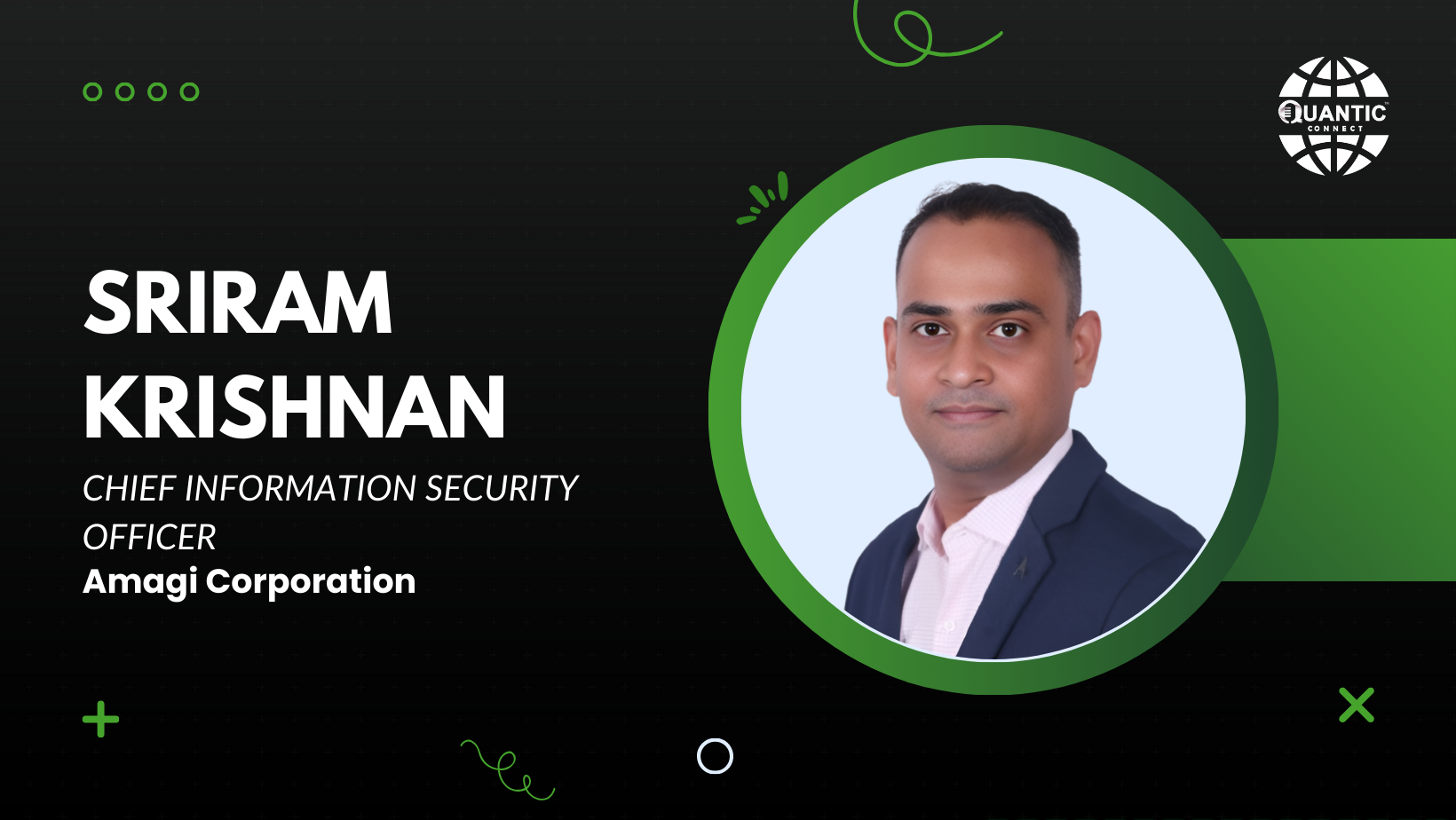
Bengaluru, 10th September 2025: In today’s digital-first economy, CISOs are no longer just guardians of compliance, they have become enablers of trust, agility, and sustainable growth. As cyber threats escalate, cloud-native adoption accelerates, and AI reshapes the enterprise landscape, security leaders must strike a delicate balance between protecting critical assets and fuelling innovation. This shift demands more than tools and processes; it requires vision, adaptability, and leadership that embeds security seamlessly into business velocity.
In this conversation with Mr. Marquis Fernandes, who leads the India Business at Quantic India, a seasoned CISO Mr. Sriram Krishnan, Chief Information Security Officer, Amagi Corporation shares how he approaches this balance. He reflects on aligning strategy with on-ground execution, moving beyond checklist compliance to foster a true security-first culture, and applying AI responsibly in cybersecurity. Drawing from his leadership journey, he also emphasizes the importance of continuous learning and creating a safe environment where mistakes fuel growth, highlighting how people-first principles ultimately transform cybersecurity into a strategic enabler of innovation and resilience.
Q. In your view, how can CISOs balance the trade-off between security enforcement and business agility without slowing innovation?
I often use the analogy of mid-air refueling an aircraft. A plane cannot afford to land every time it needs fuel; it must continue flying while being replenished. Similarly, scaling businesses cannot pause for security, it must be embedded seamlessly into their growth journey.
The reality is that velocity will inevitably be impacted. However, the goal of a CISO is to ensure that this impact doesn’t derail revenue or innovation. To achieve that balance, I focus on three principles:
a) Prioritize high-impact risks – Focus on risks that could significantly affect business outcomes, rather than trying to address everything at once.
b) Drive alignment and communication – Ensure goals and tactical plans are not only well-defined but also shared, understood, and accepted by key stakeholders across the organization.
c) Measure and adjust – Establish clear metrics to track progress, communicate status, and enable timely course correction if things veer off track.
Based on tried and tested experience, when done right, security shifts from being a blocker to becoming an enabler of sustainable innovation.
Q. As a senior leader, how do you align high-level strategy with on-the-ground engineering execution?
My point of view is that a leader should bridge strategy and execution by considering two factors – philosophy and clarity on outcomes:
a) Philosophy – Every leader should have a guiding philosophy toward technology and execution. For example, I am a strong advocate of open source, and I often shape my teams’ approach and choices around this principle. Having such a focal point helps create consistency in decision-making.
b) Clarity on outcomes – One must be clear about the desired end state. Once the outcome is well-defined, the execution plan can be reverse engineered around it, ensuring that every engineering decision directly contributes to the strategic objective.
I believe that this combination of philosophy and outcome-driven planning creates a strong alignment between vision at the top and execution on the ground.
Q. Many organizations treat compliance as a checklist. How do you transform it into a security-first culture that employees genuinely adopt?
The goal should be building secure systems, compliance will follow as a natural result. A security program must always be risk-driven otherwise it reduces to box-ticking with little connection to business objectives. It is the responsibility of the CISO to communicate to the business leaders the impact of addressing the risk and how it fits to the overall business goals. In turn, when business leaders enable their teams to understand the risks, compliance becomes more meaningful rather than just being a checklist-driven activity. Security thrives only through partnership, not ownership. And culture, at its core, is a blend of awareness and behavior. When both align, compliance follows.
Q. What’s the most tech buzzword right now? What are your honest views on it?
AI is undoubtedly the most talked-about technology today. My honest view is that it remains a work in progress. Organizations need to find the middle ground, avoiding blind hype while not holding back where genuine potential exists. History teaches us that innovations sustain only when they truly improve lives and deliver measurable business impact.
In cybersecurity, AI holds tremendous promise, from detection engineering to incident response and security bug mitigation. The key is to focus on meaningful applications that deliver tangible, quantifiable ROI, rather than chasing the buzz. The future of AI in security will be defined not by the noise around it, but by the outcomes it creates.
Q. What’s the best career advice you’ve ever received, and how has it shaped your leadership?
The best career advice I ever received was: “Treat life as a series of experiences and never stop learning”. I’ve never allowed myself to feel like I have arrived. Instead, I constantly seek opportunities to learn from every walk of life, and just as importantly, to share those lessons so others can grow as well.
As Richard Feynman once said, “You keep on learning and learning, and pretty soon you learn something no one has learned.” That mindset has shaped my leadership by making curiosity, humility, and knowledge-sharing central to how I build and guide teams.
Q. How do you help your team learn from mistakes without fear?
One of the most valuable lessons I learned early in my career, from leaders I admired, is that if you’re not making mistakes, you’re probably not taking enough risks. And without risk, there is no growth.
I’ve always communicated this principle wherever I work. When people know that mistakes are treated as learning opportunities, they take greater ownership, act more responsibly, and build confidence. They may stumble, but they also know they will come back stronger, and that is how individuals and teams truly grow.
Effective cybersecurity leadership is less about tools and checklists and more about vision, alignment, and people. As this dialogue highlights, security done right is not a barrier but a catalyst, one that empowers organizations to innovate confidently, navigate risks with resilience, and cultivate teams inspired by purpose rather than fear. In a world where technology will keep evolving and threats will never disappear, it’s this blend of curiosity, clarity, and courage that sets great leaders apart and transforms security into a true business differentiator.
