



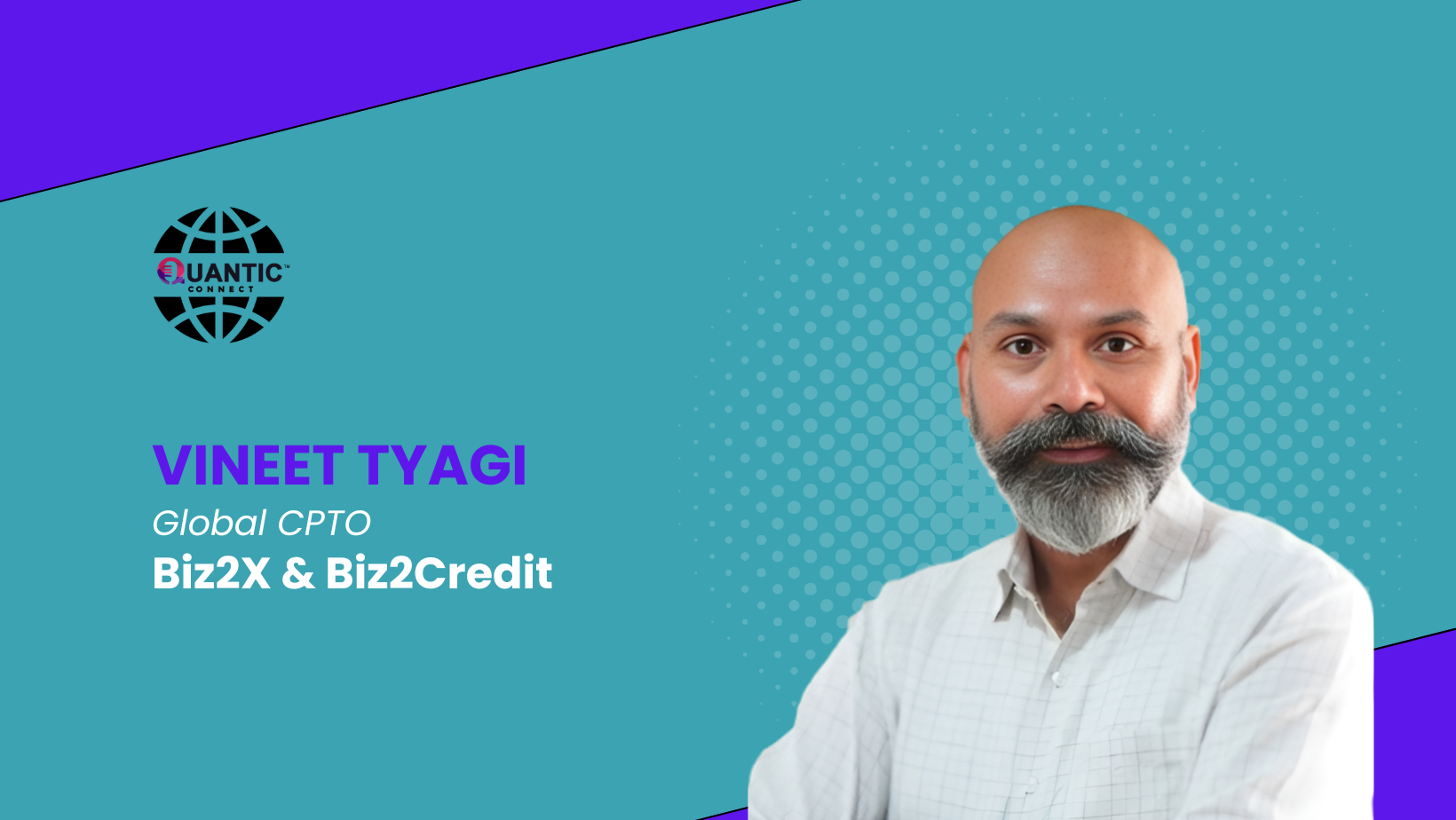
Delhi, 24th October 2025: In today’s fintech landscape, agility, resilience, and trust are the ultimate differentiators, and few leaders embody this balance as seamlessly as Mr. Vineet. From architecting LangChain, powered bots to building enterprise, grade SME lending platforms, he has consistently pushed the boundaries of what AI can deliver while ensuring regulatory confidence and product scalability across geographies.
Join Mr. Vineet Tyagi, Global CPTO at Biz2X & Biz2Credit in an engaging and interesting conversation with Mr. Marquis Fernandes who spearheads the India Business at Quantic India, In this candid conversation, Vineet shares the architectural choices, leadership philosophies, and strategic principles that have guided his journey, spanning innovation, governance, talent building, and the evolving future of AI, led financial systems.
From launching LangChain bots to deploying SME lending platforms at scale, what are the top three architectural decisions you made that enabled agility and resilience in AI, led fintech systems?
One of the biggest calls was to decouple data and intelligence layers early. In lending, you can’t afford a monolithic core, the ability to plug in new models without rewriting the entire stack gave us speed and resilience. Second, I leaned heavily on event, driven architecture. Credit, payments, fraud checks , these are asynchronous by nature, so streaming pipelines allowed us to scale smoothly without locking into rigid workflows. Third, we made explainability a design principle, not an afterthought. Whether it’s a LangChain bot or a credit scorecard, transparency keeps regulators comfortable and teams confident. Those three choices, modularity, real, time design, and explainability, are what made our AI systems both agile and battle, hardened.
How do you balance rapid product innovation with governance and policy needs when advising on AI frameworks across geographies like the US, India, and UAE?
Balancing innovation with governance starts with recognizing that policy is not a brake, it’s the guardrail. In markets like the US, India, and the UAE, the appetite for AI innovation is huge, but the regulatory lens differs. I usually frame product development in two tracks: one that runs fast with experiments, and another that stress, tests for compliance, explainability, and auditability. This way, teams don’t feel slowed down, but regulators see that we’re being proactive. The key is to embed policy awareness into the design stage, so by the time you’re scaling, you’re not fighting fires. In short, I see governance as part of the product DNA, not a bolt, on.
What differentiates a high, impact Global Capability Center (GCC) from an average one, especially when it comes to AI and digital infrastructure delivery?
A high, impact GCC doesn’t just execute tasks; it owns outcomes. While the average GCC is focused on cost savings and headcount, the real differentiators are product ownership, speed of decision, making, and ability to influence the global roadmap. When it comes to AI and digital infrastructure, a top, tier GCC invests in talent density and cross, functional squads , data, product, engineering, and compliance working as one team. It also shifts from being a “service center” to a center of experimentation, where new models, platforms, and pilots are first tested. Finally, impact GCCs are measured not just by delivery metrics but by how many ideas they originate and scale globally. That’s what separates leaders from followers in the AI age.
With your experience in scaling engineering teams globally, how do you identify, mentor, and retain product, tech talent capable of building $300M+ enterprise tools?
When I look for talent, I don’t just check for skills, I check for ownership mindset. The engineers and product leaders who end up building $300M+ platforms are the ones who see beyond tickets and sprints, and think in terms of outcomes. Mentorship, for me, is about exposure and trust, giving people a seat at the table where real decisions happen, and backing them when they take bold calls. Retention is less about perks and more about creating an environment where talent feels they’re growing faster inside than they would outside. Over time, that blend of ownership, mentorship, and growth builds teams that don’t just deliver enterprise tools, they deliver enterprise impact.
How is the future of SME underwriting being shaped by AI, and what role do you see large language models playing in real, time credit decisioning?
The old way of SME underwriting leaned too much on static PDFs and backward, looking numbers. What’s happening now is a shift toward live data and instant calls, and AI is what makes that possible. Models can scan POS flows, GST returns, or transaction trails in seconds and highlight risks or strengths that a human would miss under pressure. Large language models take that raw intelligence and put it into plain words, so a credit officer or regulator can actually follow the logic. That makes the process faster, but more importantly, it makes it easier to trust. For SMEs, it means their data starts telling their story directly, not just the paperwork they file once a year.
If there were one analogy to explain complex fintech concepts to non-tech stakeholders, something so simple that it never fails, what would it be?
I often compare fintech to traffic on a busy highway. Banks are the roads, fintechs are the vehicles, and AI is the GPS that helps you navigate in real time. Everyone instantly gets it, because if you’ve ever sat in traffic, you know the pain of inefficiency and the joy when the right signal clears the way. It’s my go, to analogy that never fails to click.
You’ve been honored by Forbes, MIT, and more, but what’s one personal win or compliment that still gives you goosebumps?
Awards are great, but the one that still gives me goosebumps was when my son told someone, “My dad builds things that actually matter.” It was unscripted, honest, and said with the kind of conviction no jury can match. That compliment sits quietly at the top of all my trophies.
Can you share your favorite icebreaker or offbeat question for team meetings?
My favorite icebreaker is: “If you had to delete every app on your phone except three, which ones would you keep?” It’s simple, but it always sparks laughter and debate, especially when someone fights hard for a food delivery app over WhatsApp. It tells you more about a teammate’s priorities than any resume ever could.
How do you make sure strategy isn’t just a slide deck but a lived practice?
I tell my teams that a strategy locked in a slide deck is just “corporate art.” The real test is whether people can explain it in their own words and act on it without looking at the slides. If I hear it repeated in town halls, stand, ups, and even coffee chats , then I know it’s alive, not just decoration.
What does your personal learning stack (books, tools, routines) look like?
My learning stack is pretty simple. I always have a few books going, usually one on tech, one on history, and something totally random. Trekking and travel give me the headspace to think differently; some of my best ideas have shown up halfway up a trail, not in a meeting room. And I like tinkering, sometimes with AI models, sometimes just with side projects that may never see daylight, but they keep me curious.
As this conversation with Mr. Vineet Tyagi highlights, the future of fintech is not just about technology but about vision, architecting systems that are modular yet resilient, fostering teams that think in terms of outcomes, and embedding governance as a natural part of innovation. His journey demonstrates that true impact lies in balancing speed with trust, experimentation with accountability, and global scale with local nuance. For leaders, innovators, and practitioners alike, his insights serve as both a blueprint and an inspiration for building AI, driven financial systems that don’t just work, but endure.
