



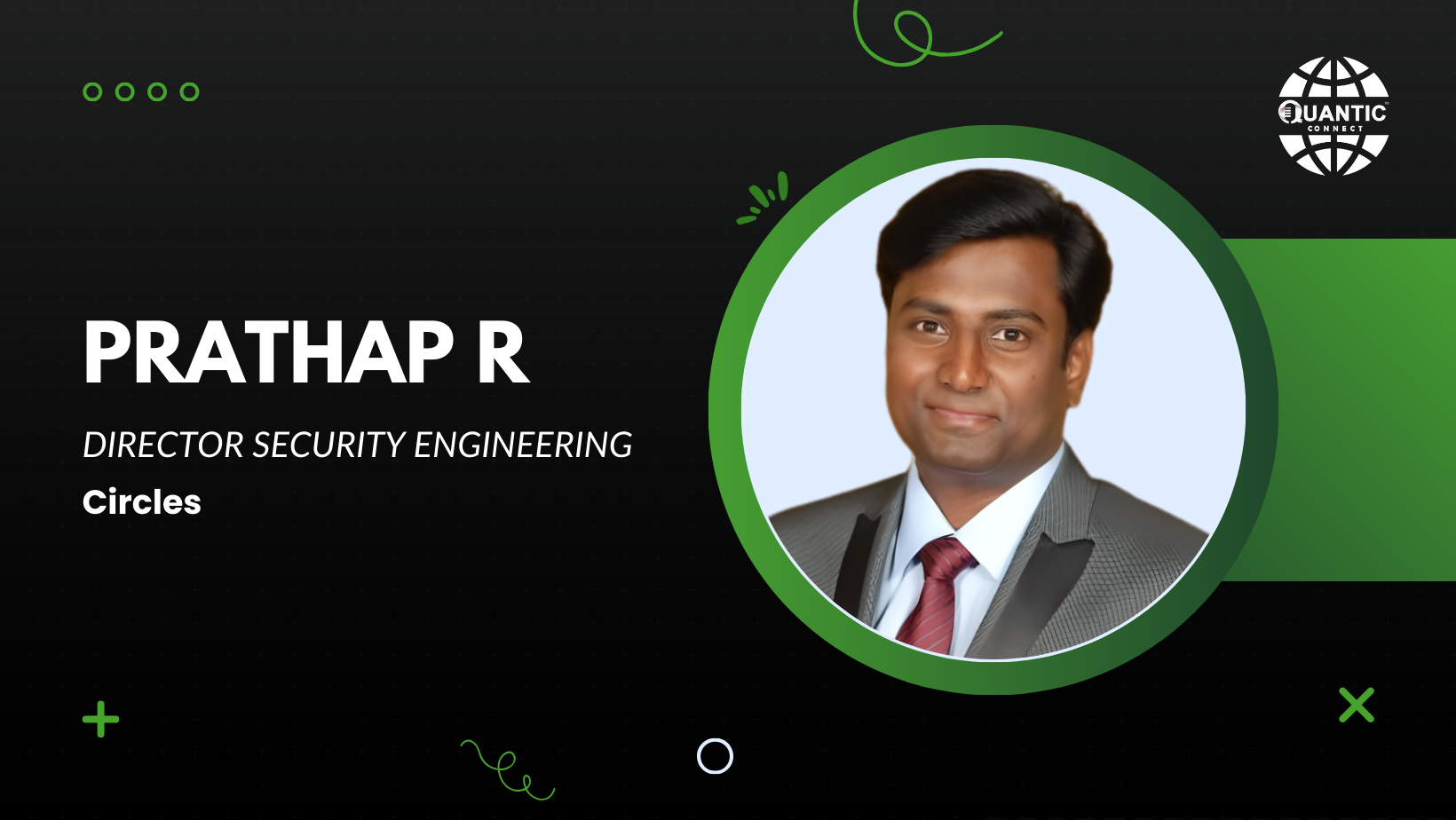
Delhi, 4th September 2025: In today’s hyper-connected world, rapid innovation and evolving cyber threats demand security leaders who can think strategically, act decisively, and adapt continuously. With such changes, it becomes a leader’s responsibility to weave security into development lifecycles, build resilient cultures, and leverage AI to anticipate emerging threats. This article highlights that modern cybersecurity is not just about controls, but about enabling business growth, fostering team collaboration, and turning security into a competitive advantage.
Join Mr. Marquis Fernandes (Director – India Business, Quantic India) in this candid conversation with Mr. Prathap R who is the Director Security Engineering at Circles. Together, they delve into hands-on strategies, from creating security champions within product teams, integrating automation seamlessly into workflows, to guiding teams through high-pressure scenarios and learning from real-world failures. Through these examples, Mr.Prathap demonstrates how leadership that balances technical excellence with empathy can safeguard critical systems while empowering teams to innovate confidently.
Q. In your experience, how can Product Security and DevSecOps teams work together without slowing down innovation?
As a senior cybersecurity engineering leader, I see successful collaboration between Product Security and DevSecOps teams as essential to maintaining a balance between strong security and rapid innovation. Here are key approaches to achieve this without slowing down innovation:
- Shift Security Left: Embed security early in the development lifecycle by involving Product Security teams in initial threat modeling and secure design phases. This reduces rework and security issues downstream while keeping development fast.
- Automate Security Processes: DevSecOps should leverage automation for security testing such as static and dynamic application security testing (SAST/DAST) directly integrated into CI/CD pipelines. Automation provides immediate feedback to developers, preventing security from becoming a bottleneck.
- Integrate Security into Developer Workflows: Security tools need to fit seamlessly into developers’ existing environments (IDEs, pull requests) so they can address vulnerabilities as part of their usual workflow without disruption.
- Foster Collaboration, Communication & Shared Responsibility: Break down silos across product, security, and operations teams with regular cross-functional meetings and shared goals. Security becomes a collective responsibility rather than a gatekeeping function.
- Use Secure Coding Standards and Infrastructure as Code: Encourage secure coding practices and automate infrastructure provisioning through code (IaC) to ensure consistent security posture without manual delays.
- Prioritize Security Issues to Enhance Developer Trust: Use security tools with low false positives and prioritize actionable vulnerabilities to avoid overwhelming developers, enabling focused remediation that supports innovation speed.
- Continuous Security Monitoring and Feedback Loops: Even after deployment, continuous monitoring and rapid response capabilities help maintain security posture without halting development cycles.
Q. What’s one unconventional security strategy you’ve implemented that delivered surprisingly high impact?
One unconventional security strategy I implemented that delivered surprisingly high impact was the adoption of a “security champions” program embedded within product and engineering teams. Instead of centralized security teams solely owning security responsibilities, we identified and trained passionate engineers across various product teams to serve as security advocates or champions.
These champions acted as the first line of defense, conducting peer code reviews with a security lens, promoting secure coding practices, and bridging the gap between security and development. This decentralized approach not only increased security awareness organically but also significantly reduced vulnerability turnaround times by empowering those closest to the code.
The impact was twofold: it scaled security expertise across the organization without linear increases in headcount, and it fostered a culture where security became a natural part of the development process rather than an afterthought or roadblock. This strategy improved both security posture and developer engagement, accelerating secure delivery in ways traditional security models couldn’t achieve alone.
Q. If you had to design a global security program from scratch today, what would be your top three non-negotiable pillars?
If I were designing a global security program from scratch today, my top three non-negotiable pillars would be:
- Culture of Security and Shared Responsibility: Security must be ingrained in the organizational culture with buy-in from the C-suite down to every individual contributor. Everyone should understand their role in protecting the organization’s assets, fostering continuous awareness, accountability, and proactive security behavior. This culture reduces risks born from human error and aligns security objectives with business goals.
- Security by Design with Integrated Automation: From the outset, security controls need to be embedded into every phase of the product and infrastructure lifecycle, design, development, deployment, and operations. This pillar emphasizes shift-left practices, automated security testing integrated in CI/CD pipelines, and infrastructure as code. Automation accelerates detection and remediation, enabling scaling without sacrificing security.
- Comprehensive Visibility and Adaptive Response: A global program must have centralized, real-time visibility across all environments, on-premises, cloud, and hybrid. This includes continuous monitoring, threat intelligence integration, and advanced analytics powered by AI/ML for rapid detection of anomalies. Coupled with automated and orchestrated response capabilities, this ensures the organization can adapt and respond dynamically to evolving threats worldwide.
Q. Beyond Compliance: How can security leaders future-proof their organization’s cyber defenses in an era of AI-driven threats?
To future-proof an organization’s cyber defenses in the era of AI-driven threats, security leaders need to go beyond compliance by adopting a multifaceted strategy:
- Leverage AI for Proactive Threat Detection and Automated Response: Use AI-powered platforms to analyze vast amounts of data and build dynamic behavioral baselines for users, devices, and applications. AI can detect sophisticated, evolving threats like hyper-realistic phishing, deepfake scams, and adaptive malware faster than traditional systems. Automated containment and remediation reduce damage and response times significantly, shifting the security posture from reactive to proactive.
- Implement Robust AI Governance and Security Frameworks: Protect AI assets and models with frameworks such as NIST AI Risk Management Framework (RMF) that address risks like adversarial machine learning (attacks targeting AI defenses) and “Shadow AI.” This includes securing AI development, APIs, and operational environments to mitigate the risk that attackers exploit AI capabilities against defenses.
- Adopt a Security-First Culture with Continuous Training: Since AI-driven attacks increasingly exploit human vulnerabilities via social engineering and targeted scams, ongoing employee training and awareness remain critical. Cultivating vigilance combined with AI-driven insights creates a resilient workforce capable of recognizing and avoiding sophisticated threats in real time.
Q. If you could design a security culture starter kit for teams, what would be in it?
A security culture starter kit for teams should empower every member to take ownership of security in their day-to-day work while fostering collaboration and awareness. Here’s what I would include:
- Clear Security Vision and Principles: A concise, inspiring statement on why security matters to the organization and key behaviors expected from every team member.
- Role-Based Security Responsibilities: Tailored checklists or guides highlighting what security means for different roles, developers, product managers, operations, QA, etc., to embed accountability.
- Interactive Security Training and Awareness: Engaging modules on secure coding, phishing recognition, data protection, and emerging threats, coupled with regular refreshers and simulated phishing campaigns.
- Practical Security Tools and Resources: Access to security automation tools, cheat sheets for secure coding practices, incident reporting channels, and vulnerability management dashboards integrated into daily workflows.
- Metrics and Feedback Loops: Dashboards displaying relevant security KPIs and channels for teams to share security challenges and successes, reinforcing continuous improvement.
- Recognition and Reward System: Mechanisms to acknowledge and celebrate security champions and proactive behaviors, motivating sustained engagement.
- Leadership Role Modeling: Visible commitment from leadership through regular communication, participation in training, and prompt support for security initiatives.
Q. How do you motivate your team when they’re feeling burnt out or stuck?
Motivating a cybersecurity team facing burnout or feeling stuck requires a balanced approach focused on empathy, empowerment, and purpose:
- Acknowledge and Listen: Start by genuinely acknowledging their feelings and creating a safe space for open dialogue. Understanding individual and team stressors is crucial before addressing them.
- Redistribute Work and Prioritize: Help the team focus on high-impact tasks by reassessing priorities. Remove or delegate lower-value activities to reduce overwhelm and create breathing room.
- Inject Variety and Growth Opportunities: Rotate responsibilities or introduce new challenging projects that align with their interests and career goals. Learning and skill development can re-energize passion and engagement.
- Celebrate Wins, Big and Small: Regularly highlight accomplishments and progress to build momentum. Positive recognition fosters a sense of achievement and boosts morale.
- Promote Work-Life Balance and Mental Health: Encourage taking breaks, flexible schedules, and utilizing wellness resources. Modeling and supporting self-care is vital in preventing burnout.
- Reinforce Purpose and Impact: Remind the team how their work protects the organization, customers, and critical infrastructure. Connecting daily tasks to a larger mission enhances motivation and resilience.
- Foster Supportive Collaboration: Strengthen team cohesion through peer support, mentoring, and collaborative problem-solving, making challenges feel shared rather than isolating.
By blending empathy with tangible actions that reduce stress and enhance engagement, leaders can help cybersecurity teams overcome burnout and regain momentum toward their critical mission.
Q. What’s the biggest lesson you learned from a failed deployment?
The biggest lesson I learned from a failed deployment is the critical importance of comprehensive testing and gradual rollout strategies, particularly around security controls.
In one instance, a security feature was pushed globally without sufficient staging and phased deployment, which led to unexpected system outages and degraded user experience. This failure highlighted that no matter how robust a feature looks in development, real-world environments can reveal unforeseen integration issues, performance impacts, or dependencies.
Key takeaways were:
- Always perform extensive end-to-end testing in environments that closely mimic production.
- Use canary or phased rollouts to mitigate risk, observe system behavior, and gather user feedback before full deployment.
- Maintain clear rollback plans and communication channels ready in case issues arise.
- Involve cross-functional teams early to surface potential operational impacts and dependencies.
This lesson reinforced that security and innovation can coexist only when deployment practices prioritize stability, resilience, and collaboration, ensuring secure features reach users smoothly without disruption.
Q. Which moment made you realize you truly belonged in this profession?
The moment I truly realized I belonged in cybersecurity was during a critical incident early in my career where a sophisticated attack threatened to compromise sensitive customer data. As part of the response team, I worked tirelessly alongside cross-functional experts to analyze the breach, contain the threat, and develop rapid mitigations.
Seeing firsthand the immediate impact our decisions had on protecting people’s trust and the organization’s integrity was profoundly fulfilling. It was a moment where my technical skills, problem-solving mindset, and sense of responsibility converged in a high-stakes environment.
That experience cemented my purpose in cybersecurity, not just as a technical challenge but as a mission to safeguard critical assets, enable safe innovation, and defend the digital world. It’s a profession where every day offers meaningful impact, and that realization made me certain I belonged here.
The future of cybersecurity belongs to leaders who can balance rigor with agility, embed security seamlessly into business workflows, and inspire teams to see security as a shared mission rather than a constraint. Whether it’s anticipating threats with AI, nurturing security-first cultures, or learning from failures, the essence of lasting resilience lies in bridging technology with people and purpose. Cybersecurity is no longer a backroom function, it is a frontline enabler of innovation and trust, shaping how organizations thrive in an uncertain digital era.
