



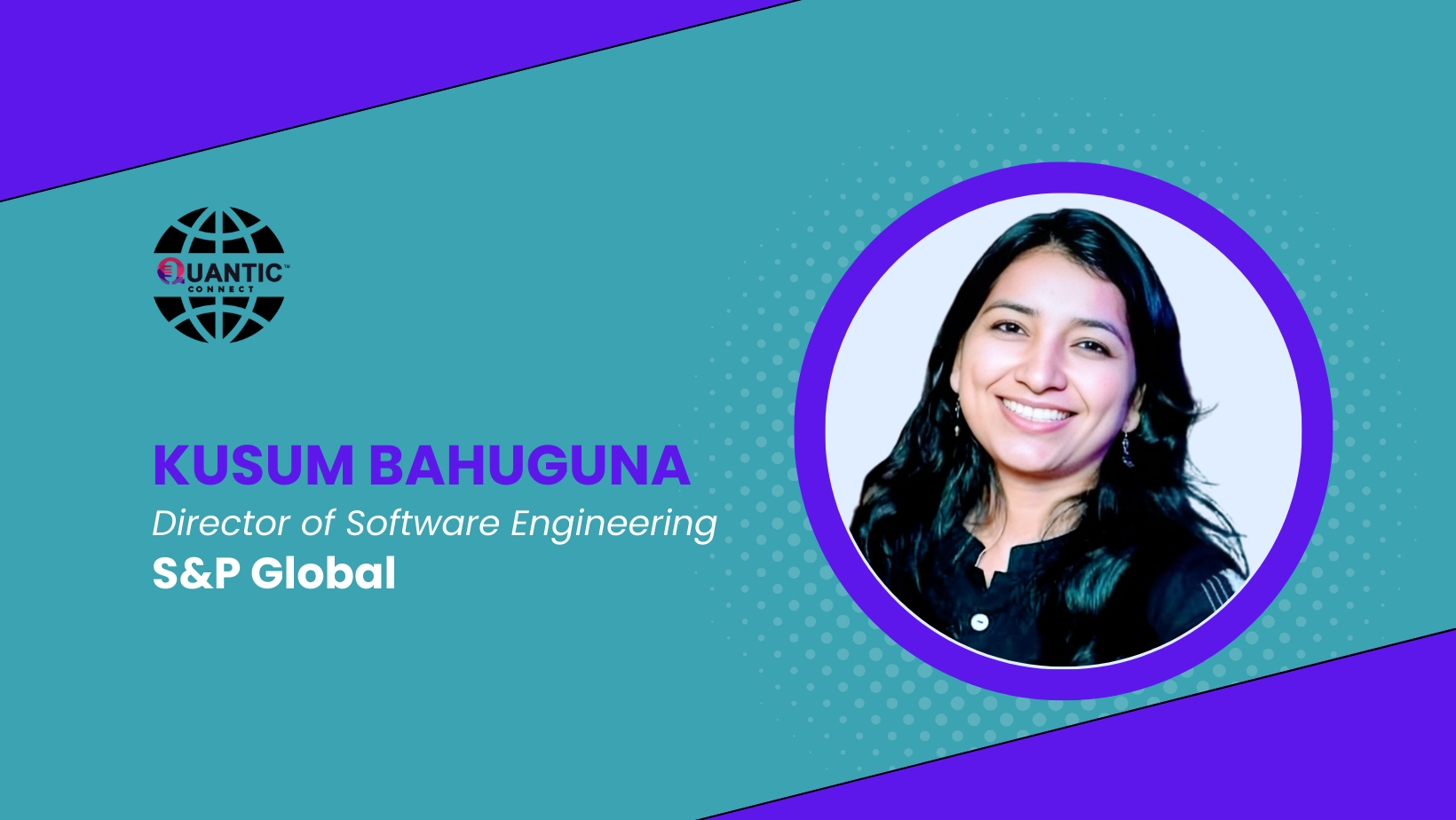
Delhi, 1st September 2025: Climbing the tech ladder is not just about mastering technical skills; it’s a profound journey of personal and professional transformation. As leaders evolve, they shift their focus from purely technical expertise to embracing growth, communication, emotional intelligence, and collaboration. This holistic approach not only strengthens their ability to lead teams effectively but also fosters a culture of continuous learning and innovation. Navigating complex client environments and balancing immediate challenges with long term goals become integral parts of this leadership journey, ultimately driving engineering maturity and delivering lasting impact.
In this insightful conversation, with Mr. Marquis Fernandes (Director – India Business at Quantic India), Ms. Kusum Bahuguna who is the Director of Software Engineering at S&P Global reflects on the personal transformation from a purely technical expert to a growth oriented leader who champions communication, emotional intelligence, and collaboration. She mentions how embracing continuous learning and balancing immediate delivery pressures with long term strategic goals has shaped her approach to engineering leadership. Sharing practical perspectives on building future proof systems and cultivating engineering maturity, Ms.Kusum highlights the measurable impact of fostering data driven practices and a culture of innovation that enables teams and clients to thrive in complex, ever evolving environments.
What’s the biggest personal transformation you underwent while climbing the tech ladder?
The biggest personal transformation I experienced while climbing the tech ladder was evolving from a technical focus to a leadership mindset that values growth, communication, emotional intelligence, and collaboration. This journey has not only enhanced my professional capabilities but also enriched my personal development, allowing me to contribute more meaningfully to my teams and the organization as a whole.
What’s a non-technical book or movie that surprisingly shaped how you lead or solve problems in software engineering?
One non-technical book that surprisingly shaped my approach to leadership and problem-solving in software engineering is Stephen R. Covey’s “The 7 Habits of Highly Effective People.” Although it is not specifically about technology or software development, its principles offer profound insights that can be directly applied to leading teams and tackling challenges in the tech industry. Proactivity, Begin with the End in Mind, Synergy, Continuous Improvement, Think Win-Win
How do you create a culture of continuous learning in your team?
As a leader, I demonstrate my commitment to continuous learning by actively pursuing my own development. Whether through attending workshops, reading industry-related books, or sharing insights from my experiences, I show the team that learning is a lifelong journey. Recognizing and celebrating learning achievements is crucial for reinforcing a culture of continuous improvement. I make it a point to acknowledge team members who complete courses, share new knowledge, or implement innovative solutions based on their learning.
In an era of constant innovation, how do you ensure your engineering decisions remain relevant while also being future-proof, especially in complex client environments?
Regular feedback loops with clients are essential as they allow for adjustments that align with their evolving needs, ensuring that engineering solutions remain applicable. A commitment to learning helps teams stay abreast of new technologies, tools, and best practices, which can be integrated into current projects. When designing systems and solutions, it is crucial to prioritize scalability and flexibility, meaning that architectures should be created to easily accommodate growth or changes in client needs without requiring a complete overhaul. Additionally, regularly monitoring industry trends and technological advancements is vital for maintaining relevance in a constantly changing landscape.
As a go-to escalation point, how do you balance urgency and long-term impact when unblocking teams under delivery pressure?
Balancing urgency and long-term impact require a strategic approach that prioritizes solutions addressing immediate issues while also aligning with long-term goals. It is essential to encourage teams to take ownership of their challenges and involve them in the decision-making process, as this fosters accountability and can lead to innovative solutions that consider both urgent and long-term impacts. After resolving urgent issues, conducting retrospectives becomes crucial to analyse what led to the pressure and how similar situations can be prevented in the future. This reflective practice not only helps in mitigating future risks but also reinforces a culture of continuous improvement within the team.
You often help clients move to a ‘higher state of maturity.’ How do you define maturity in engineering practices, and what measurable signs indicate that a client has genuinely evolved?
Focusing on data and metrics is essential for assessing the current state of engineering practices. For instance, the number of defects or issues reported post-deployment serves as a key indicator of the effectiveness of these practices, while delivery speed for medium features provides insight into the team’s efficiency. There are many additional metrics we can monitor to gauge our current status, and we continuously check and improve upon them. By recognizing measurable signs of evolution, such as improved delivery speed, reduced defects, and increased customer satisfaction, organizations can effectively evaluate their progress and enhance their engineering capabilities. Ultimately, fostering a culture of maturity not only improves operational efficiency but also drives innovation and contributes to client success.
