




Bengaluru, 8th August 2025: When it comes to building scalable, resilient, and future ready systems, the decisions made at the architectural level can define the success, or struggle of every phase that follows. In this conversation, we explore the foundational choices behind high performing microservices, the realities of AI integration in regulated industries, and strategies for nurturing innovation driven engineering teams. Along the way, we also uncover personal philosophies, surprising lessons, and even a few light hearted moments from food analogies to leadership role swaps.
Join Mr. Aravindan Varadan, Senior Director at Azentio Software, in an engaging conversation with Mr. Marquis Fernandes, who leads the India Business at Quantic India, as they reflect on the pivotal moments, mindsets, and challenges that have shaped Aravindan’s journey across tech and leadership.
When designing scalable microservices, what’s the one architecture decision you believe every leader must get right from day one, and why?
In a microservices architecture, each microservice typically encapsulates a single, well defined unit of business functionality. This architectural style is favored not only for its scalability but also because it adheres to key design principles such as service isolation, independent deployment, and autonomous development. Development teams can independently build, test, and release their services, often using different programming languages or technology stacks that best suit their use case. This promotes maintainability and agility across the system.
In the early stages of development, this siloed service ownership can offer a major advantage, as teams primarily focus on their own services. This often leads to faster iteration cycles and reduced coordination overhead. However, challenges typically emerge during integration phases, especially when services built by different teams need to interact reliably.
One of the critical best practices that must be enforced from the initial design phase is proper version management:
- Application versioning
- Individual microservice versioning
- Compatibility tracking via a certification matrix
The certification matrix is essentially a compatibility reference that maps microservice versions and their interoperability with other dependent service versions. It should clearly indicate:
- Which versions of Service A are compatible with which versions of Service B
- Whether the compatibility is forward-compatible (newer versions work with older ones) or backward-compatible (older versions work with newer ones)
Neglecting these foundational practices can lead to integration failures, deployment bottlenecks, and significant rework in later stages of the development lifecycle.
A sample certification matrix is given below:
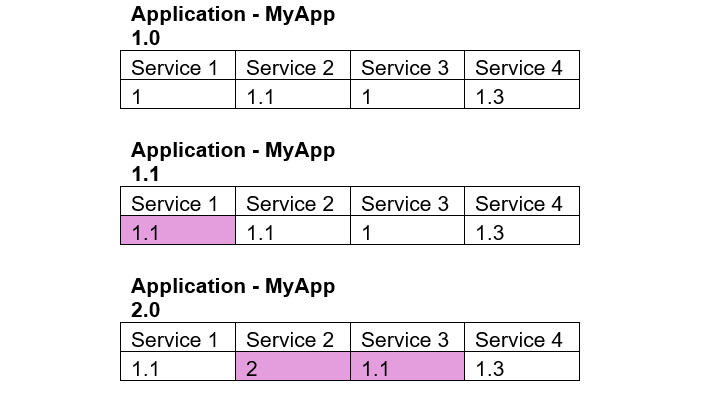
As shown above, in MyApp version 1.1, Service 1 was upgraded to version 1.1. This version was backward-compatible and did not require any changes in other services. The update was non-breaking and integrated seamlessly with existing versions of Service 2, Service 3, and Service 4.
However, with the release of MyApp version 2.0, Service 2 was upgraded to version 2.0. This introduced breaking changes that affected the functionality or API contracts of Service 3, which then had to be updated to version 1.1 to maintain compatibility.
To handle such version dependencies in a structured and scalable manner, it is highly recommended to:
- Maintain a centralized Version Registry (Metadata Repository) that documents:
- Each application version
- Corresponding microservice versions
- Compatibility mappings between services
- Integrate this version registry with the Application Orchestrator so that:
- The orchestrator can dynamically route requests to the correct versions of microservices.
- Runtime service coordination can be based on metadata driven compatibility rules.
This approach enhances system resilience, supports graceful service upgrades, and enables smoother integration testing and deployments.
Having mentored teams from scratch, what’s your go-to strategy for turning promising talent into high performing, innovation driven engineers?
Having built multiple Centres of Excellence in areas like Data Science, DevOps, and AppSec from the ground up, I’ve often worked with teams comprising both interns and mid-level professionals. The first step I take is to define a clear, inspiring, and measurable vision that aligns with the organization’s strategic goals. This gives the team a purpose larger than their day-to-day tasks.
Next, I focus on enhancing each individual’s career value by providing targeted mentorship. I begin by identifying each team member’s strengths and aligning their responsibilities with real world challenges that stretch their capabilities. I actively encourage them to take ownership by leading initiatives and solving problems that matter. A key part of this approach is fostering a mindset that challenges the status quo, especially by identifying manual or repetitive tasks and exploring how they can be automated using modern technologies. To further support their growth, I also integrate industry relevant certifications into their annual performance objectives, helping them stay current and build credibility in their field.
I make sure to reward innovation, promote their contributions to senior leadership, and demonstrate how their work creates organizational impact. This builds confidence, a sense of ownership, and a culture of self-motivation. The result? Promising talent evolves into high performing, innovation driven engineers who take pride in their growth and contributions.
In your journey of integrating AI into BFSI and other domains, what’s the most surprising challenge you faced that no textbook prepared you for?
In BFSI, the most surprising challenge wasn’t in building AI models, it was in navigating the complex constraints around data privacy, regulatory compliance, and legacy infrastructure.
Unlike other domains where off-the-shelf AI services or cloud APIs can be easily integrated, BFSI environments require extreme caution. You can’t simply pass customer data to external services due to strict privacy and regulatory policies. As a result, models often need to be built entirely in-house, trained on sensitive customer data within secure boundaries.
However, this leads to a major challenge: you rarely get access to production grade data in dev or test environments. Legal and regulatory barriers make it difficult to replicate real world data scenarios. To bridge this gap, we’ve had to develop strategies like synthetic data generation that mimic production patterns, requiring deep domain understanding and constant tuning once the model is deployed.
Even after deployment, it doesn’t end. You either need a dedicated team onsite or have to train customer teams to monitor, tune, and reconfigure models. Frequent changes in regulations often require rebuilding or versioning models, and ensuring compatibility with legacy datasets is painful, especially when the underlying data architecture is rigid, redundant, and fragmented.
And if the model involves forecasting or decision making, you need to embed reasoning and explainability, not just accuracy, because black box outcomes won’t pass scrutiny in audit heavy domains like banking or insurance.
Textbooks teach you model performance, but real success in BFSI AI integration lies in managing data governance, regulatory alignment, and working with aging infrastructure while still delivering innovation.
If you could swap roles for a week with any tech leader, living or historical, who would it be and what would you do first?
If I could swap roles with any tech leader for a week, I’d pick my former CTO. Not out of revenge (well, maybe just a little), but because I’d love to try doing it my way.
The first thing I’d do? Start with respect, genuinely and loudly. I’d bring all the teams together, break down the silos, and make sure everyone knows we’re in this together. No more finger pointing or blame ping pong. Just open communication, shared ownership, and maybe even some cross team memes to lighten things up.
I’d encourage engineers to collaborate beyond Jira tickets, and remind everyone that great tech is built by great people, not isolated squads buried in different Teams channels.
Because honestly, if you’re leading a tech org and people are afraid to speak up or share ideas. You’re not leading, you’re just managing chaos. And I’d rather be the kind of leader who builds bridges, not walls.
If you had to explain microservices to a 5 year old using a food analogy, what would be on the menu?
Well kid, imagine you’re going to a birthday party and there are lots of food stalls.
- One stall makes pizza
- Another makes burgers
- One has pani puri
- Another serves ice cream
- And one is just for desserts and sweets!
Each food stall is like a microservice. You don’t have to wait for one big kitchen to make everything together. If you’re craving just pizza, you walk right up and grab it, no need to wait for the ice cream to be ready!
That’s what microservices are: lots of small, separate helpers working side by side to make one awesome party.
What’s one non-technical hobby or passion that has unexpectedly made you better at solving technical problems?
I’ve got two secret weapons for solving tough technical problems, and neither involves a keyboard.
First up: Badminton! Now, I’m no PV Sindhu, but when I’m on the court, there’s zero room for distractions, no Teams pings, no email dings, just me, the shuttle, and the sweet satisfaction of smashing stress away. It’s like real life debugging: stay focused, react fast, and don’t let anything drop (literally). Bonus points: it keeps my heart happy and my energy levels high.
Second: Meditation! It’s my brain’s version of clearing the cache. A few quiet minutes each day, and suddenly I’m catching bugs faster, paying better attention in meetings, and not freaking out when the CI/CD pipeline fails right before a demo.
Together, badminton and meditation keep me centred, focused, and just the right amount of competitive, which turns out to be a pretty solid combo for a techie.
To know more about us / publish your article, reach us at
www.quanticindia.com
marquis@quanticindia.com
