


Delhi, 28th October 2025: A delicate balance between performance, scalability, and security is required in today’s fast-evolving tech landscape, building complex backend systems, whether in payment solutions or telecom hygiene platforms. System performance ensures a seamless user experience, scalability sets the trajectory for future growth, and security safeguards the very foundation of system availability. Yet, achieving all three simultaneously is a challenge many IT leaders face.
Join Mr. Vikram Singla, AVP at Airtel Digital, in an engaging conversation with Mr. Marquis Fernandes who spearheads the India Business at Quantic India, as Mr. Vikram shares insights drawn from years of hands-on experience, offering practical strategies to integrate security into everyday development, foster high-performing teams, navigate structured frameworks like SAFe and TMF, and lead with empathy and human-centric values, demonstrating that technology excellence and organizational culture go hand in hand.
From payment systems to telecom hygiene platforms, how do you strike the right balance between performance, scalability, and security when building complex backend systems?
Before going deep into ways of handling these attributes, let’s understand the definitions & relevance of these terms. System performance & security go hand in hand. While one is taking care of user experience & delight, other is fundamental block of system availability.
System performance & scalability defines future KPIs while security posture defines present matric. Performance is how fast my system can run, security dictates if my system can even run. With these simple yet very imperative differentiators, while managing higher throughputs, each one of us had been victim of compromising one or other security aspect. In the race of performance , scalability & security, as an IT professional, none of us will rank one above other, hence a very balance is needed while designing the systems.
I have followed one principle throughout: “Security is mindset and not the process”. Every single line of code written has a potential to impact performance & security. Hence the best way is to marry them, means put security postures in your way of working. I suggest to take following actions:
- Have SAST & DAST plugins in your development tool
- Have devsecops in your CICD to scan each line of code getting into prod
- In today’s world of AI, it is very important to use AI intelligently. Proper guard railing & data security is of prime importance.
- Scheduled vulnerability scans & categorising these issues.
- Keep updating code jars with the latest releases/versions.
You champion high-performance teams built on core value systems. Can you share a specific method or ritual you use to build an engineering culture that drives innovation?
I feel, team building is very simple skill if we treat our team mates as human. In today’s world, when dynamics are changing so fast & businesses are finding it challenging to be relevant & up to speed, team building becomes one of the critical aspect. In my ways of working, I follow one fundamental principle: “Build People to Build Business.” Now, as building anything strong, the core/root needs to be deep & strong, same fundamental applies to building high performing team.
Building good people is more to do with core values than superficial stuff.
I will share some of my rituals and believes which has helped me to drive strong organizational excellence by building some of the finest teams (And I am totally grateful to have such members in and around my teams)
- Before even thinking to build teams, be open & patient. Take this as planting a tree, fruits will take time, keep nurturing the seeds. Many times, I have seen people to start expecting high throughput before giving them enough time to grow.
- Be empathetic. Always be remembered your time at the level your team is today. I am sure someone took efforts to groom you for making you what you are today. So help your team to overcome self-doubt.
- Have 100% trust. And again it takes time to build trust both ways. Invest lot of time & effort understanding your team well. This is like saving account, where you need to 1st deposit before you withdraw. But once you have deposited enough that your team trusts you, mark my words, you have won people for life and not only for the work.
- Be in very good & deep communication with your team. This allows them to feel comfortable in sharing their thought process. And talk to listen but not to counter. Once you become a good listener, you will pick lot of ques from your conversation, which will help you and your team to bridge the gap.
- There is a tool called skill will matrix, which I found very handy tool to guide my conversation. For everyone’ reference, below is the layout :
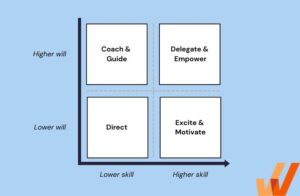
Photo credits: whatfix.com
- Lastly I feel that we shall always share the complete picture of our product/project/task on which team is working. Manier times, I have seen, people in team are so focused only on their tasks in silos that they don’t even know where their work is getting stitched in entire roadmap. Giving them this visibility, makes them feel proud of what they are part of.
Having been certified in SAFE and TMF and mentored teams in Agile, how do you practically blend structured frameworks with the fluidity required in real-world agile teams?
That’s very interesting & practical question. All these frameworks have a specific thought process behind it. Like TMF give us guiding principles to draft our solutions or products. So if we talk about TMF, it itself has multiple frameworks which help us to define say API constructs, entity models & overall information architecture. While if we talk about SAFe, it talks about scaled agile to govern lean developments, better planning & execution of products in form of PI (Program Increments). These kind of framework are always a navigator to suggest how we as an organization can benefit from industry wide principles.
And I have personally seen tremendous results while applying these frameworks. When we started SAFe in our organisation, product delivery was working in scattered manner as in each piece of architecture was running on its own silos. Multiple teams were running their own squads & there was always a dependency tracker being manually followed. With introduction of SAFe & PI Planning, it started becoming crystal clear about the quarter roadmap & ceremonies like scrum of scrum helped us navigate dependency very clearly.
By now we are seeing positives of these frameworks but here comes a practical challenge. Markets & products dynamics keep changing their priority. And business is driven by these market sentiments. So if we are rigid about following these frameworks to the tee, we may miss the business priority & hence the very whole objective of delivery. Here comes the balance. So while I advocate following these frameworks, I suggest, to use them as best practice & let your product owner & engineering teams work very closely to keep adjusting the sprint outputs as per business goals. Because it is bitter reality that digitization & engineering innovations are there to empower business but not to just leveraging the frameworks.
So I will summarise this with an anecdote. Product development is like driving to office, these frameworks are like GPS & your end product is like your office where you want to drive. Keep GPS on but be agile enough to take alternate route following GPS if your daily ideal route is rushed with traffic.
You follow the mantra ‘Understand – Solve – Own & Deliver.’ Can you share an example where you applied this in life?
I feel this mantra is way of life. Being married I am sure all of us would be able to relate our day to day tussle at home. Keeping our families and office work in harmony, seems like jiggling the balls. So we can apply this principle there as well. Let me try explaining it with one real life example. Let’s say my kid is asking me to do some small stuffs over and again while I am on my phone scrolling mails or social media. Now easiest solution is, give her mobile & let her dive into screen time & stop bogging me. And the other approach is: “Understand – Solve – Own & Deliver”. Let me break this down with our given example:
Understand: When my kid is continuously asking me to do her stuff, let us understand her message behind this. She is seeking my attention. She wants to have some time with me.
Solve: Except offering screen time to her, think for some other engagement technique. Which will solve the underlying problem: “Kid is seeking time.” I will ask my kid to grab one book & I will also read my book. Both of us will keep sharing ideas from both the books. This will not only solve the issue of time with kid but also will help both of us to gain knowledge.
Own: Ownership is the key. Taking responsibility or ownership that something can be done in this situation.
Deliver: This is critical aspect of entire cycle. Even if you understood problem & devised solution but if you don’t implement, all is in vain. SO in the given example, I have made reading with my kid as a discipline. And that has helped me a lot not only to understand my kid but also to gain wisdom from books.
What’s the biggest personal transformation you underwent while climbing the tech ladder?
I will give one word answer that covers many aspects & that is “Humanity”. If we really understand organic career progression, it is always built on great human values. And I am learning this literally daily from the people around me. In my experience of meeting with leadership, more you go up the ladder, more humble you become. Leadership helped me to know myself better, groomed my own value system. It has taught me as a human, we all make mistakes but the one who learns from these mistakes, is the one who can achieve success.
And being empathic is another dimension of same sphere. We need to understand & help our team to overcome the challenges. If we just keep pushing for timelines, we can deliver the ask but we will never build anything significant. So I have learnt to push my teams for their betterment. That means push them hard for learning new things, experiment for better, innovate, and think out of the box. I will make them uncomfortable when I see someone is working in their comfort zone. And all this can be done with a fair balance if you connect with your team mates with open heart & open mind.
What do you do when you feel your team is burning out?
1st of all, knowing that team is burning out, itself needs good amount of observation. In our day to day chaos, we tend to miss the human factor & its physical limitations. And the prime important thing to note is the reason behind this burn out.
Sometime, it is merely professional alliance within one working team. People within team are not gelling well, which is making people to burn out. Here the simplest remedy is confrontation. Don’t park such tough discussion for later stage, it will stink. Get into a quick connect with people in matter & settle it down then and there.
Sometime, same can happen due to pressure from cross functional teams. Such situations definitely need next level intervention, where we should get into an agreement in terms of ownerships & priorities.
Most common burn outs are due to timelines & continuous work pressure. Such occasions have different ways to look at. 1st simpler way is to hang out with your team for short breaks. Spend informal, zero work oriented time with your fellow mates. Other way can be to do work shuffling. I personally found this very effective. What I generally plan is parallel squad & then keep rotating tasks within these squads. The rotation frequency can be as low as one quarter and as high as one year. This gives me couple of advantages. One, we create a backup team in case of any exigency. Two, personal learning horizon spread across domain & third, it breaks monotony.
So in summary if we observe our team closely and work with them as human, there can be many ways to make the work impactful & work place as an exciting place.
Through this insightful conversation, Mr. Vikram Singla underscores that building high-performing backend systems goes beyond technology, it is equally about people, culture, and mindful leadership. Balancing performance, scalability, and security requires not only technical rigor but also an empathetic, human-centric approach to team building, decision-making, and innovation. By integrating structured frameworks with flexibility, embracing security as a mind- set, and fostering trust and growth within teams, organizations can deliver resilient, future-ready solutions while cultivating a thriving workplace. Ultimately, his philosophy reminds us that true excellence in technology is inseparable from excellence in leadership and humanity.
