


Delhi, 29th September 2025: In today’s fast-paced and high-stakes technology landscape, especially within critical sectors like BFSI and healthcare, building culturally aligned and efficient engineering teams is paramount. Modern tech leaders navigate a complex blend of technical challenges and human dynamics while leveraging cutting-edge AIOps for predictive monitoring and rapid incident response. Establishing strong DevOps, DevSecOps, and SRE practices across diverse geographies remains key to sustaining operational excellence and managing pressure and burnout.
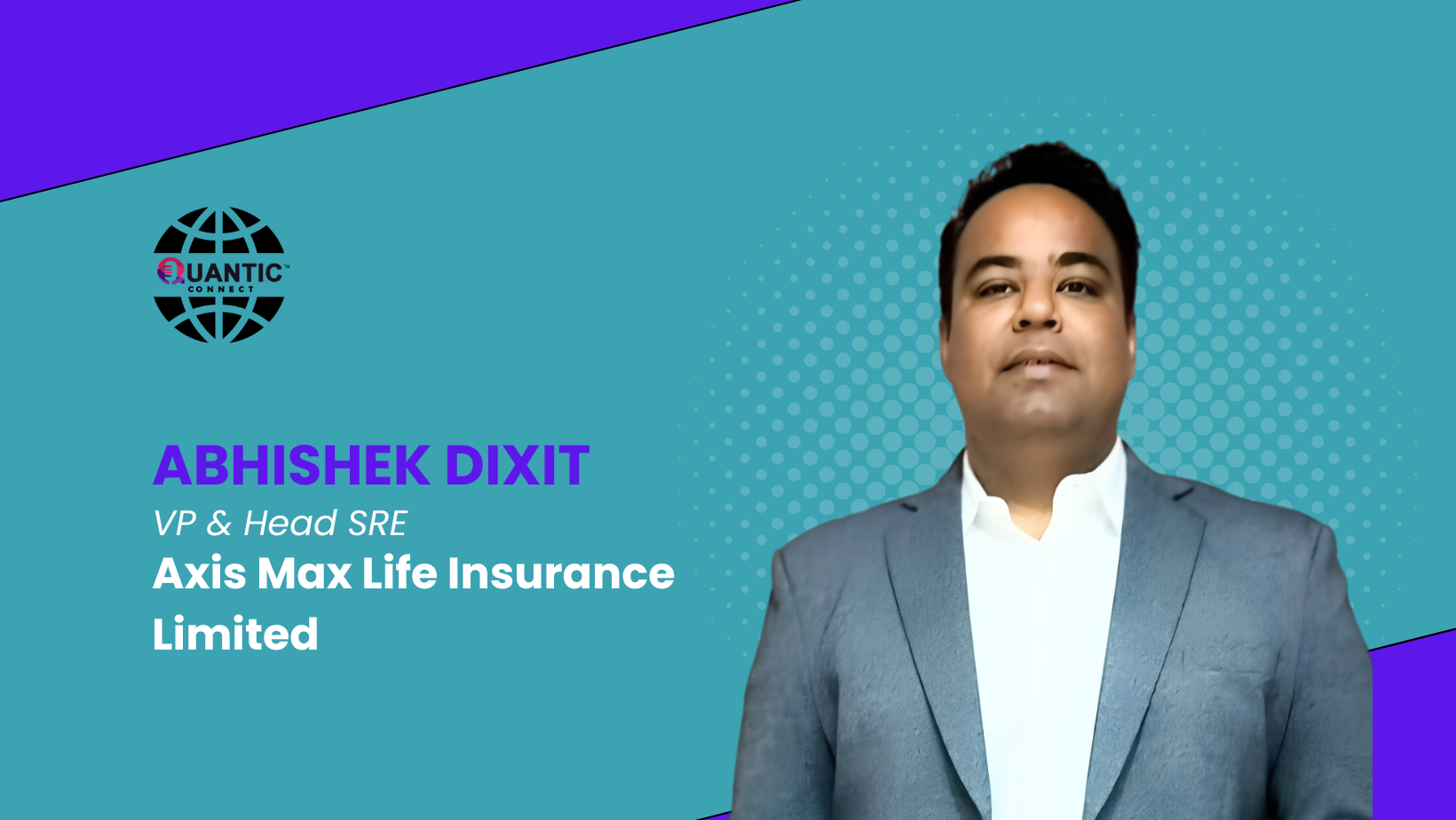
In an insightful conversation with Mr. Mr. Marquis Fernandes (Director – India Business at Quantic India), Mr. Abhishek Dixit, Vice President & Head SRE at Axis Max Life Insurance Limited, shares his journey of overcoming these challenges. He highlights the transformative impact of AIOps and predictive monitoring on business continuity, and the critical role of mature engineering functions in high-stakes environments.
In your experience, how does predictive monitoring and AIOps reshape business continuity and incident response in high-stakes environments like BFSI and healthcare?
In BFSI & Healthcare the Operational Business Continuity and Data Security are Paramount, here, AIOps Integrates predictive analytics, machine learning, and Automation to continuously monitor IT environments, Anticipate Potential Disruptions & Failures, and automate incident response. Predictive analytics leverage both historical and live data to spot early warning signs of system failures, performance issues, or security threats, enabling organizations to fix problems before they escalate and thus avoid costly downtime. AIOps automates incident response tasks such as root cause analysis, resource allocation, and remediation, heavily reducing response times and the risk of human error while freeing up IT teams for more strategic work.
You’ve built multiple global teams from the ground up. What were the non-negotiable technical foundations you always ensured while setting up DevOps/DevSecOps or SRE functions?
The non-negotiable technical foundations for building global DevOps, DevSecOps, or SRE functions include standardized and automated continuous integration/delivery (CI/CD), security integrated by design, minimal standardized paths to production, transparent access controls, continuous testing, and a fundamental networking knowledge base.
Key non-negotiable when establishing these teams are:
- Standardized CI/CD Pipelines
- Security by Design
- Access Management and Accountability
- Component and Dependency Governance
- Continuous Testing and Observability
- Leadership and Value Stream Mapping
What’s your blueprint for setting up an SRE or DevOps function from scratch, from people to process to platform, and how do you ensure sustained maturity over time?
Setting up an SRE (Site Reliability Engineering) or DevOps function from scratch involves designing the organization, processes, and technology platforms to ensure continuous improvement and mature operations. Sustained maturity requires ongoing investment in culture, metrics, and automation. A Holistic Approach for People, Process, Platform & Maturity Models with a Roadmap depicting Enablers for the Journey is required
Having worked across India, the US, and the UK, what’s an unexpected ‘tech culture’ moment that stuck with you?
What surprised me was how differently teams interpreted the same checklist based on local tech culture norms:
- In the US, engineers often leaned toward speed and iteration shipping in smaller chunks and trusting post-deployment observability to guide fixes.
- In the UK, there was a stronger bias toward governance and traceability extra sign-off steps and formal documentation before considering something truly done.
- In India, teams showed remarkable agility and cross-skilling to get things over the line, but sometimes over-extended to close gaps left by unclear upstream requirements a cultural instinct to “make it happen” even if it meant stepping outside one’s defined role.
The unexpected insight for me was that even in highly standardised DevOps/SRE environments with shared tooling, pipelines, and access controls local interpretations of quality, risk, and readiness can subtly shift operational outcomes.
Once I recognised this, we built cultural alignment loops into our processes design reviews with multi-region participants, “definition of done” refresh sessions, and release retros that compared regional practices. Over time, that helped us blend the best of speed, safety, and adaptability across the globe.
If your career journey were to be visualized as a dashboard, what would be the three quirky but meaningful KPIs displayed on it?
- Scope
- Budget
- Timeline
What do you do when you feel your team is burning out?
- Detect Early Through Signals
- Stabilize the Immediate Pressure – Rotate / On Call, Comp Off, Clarify Priorities, Reduce Volume Temporarily
- Adjust the System & Process, Not Just the People – Improve Automation, Recalibrate SLI & SLO, Normalize Cross- Skilling
