



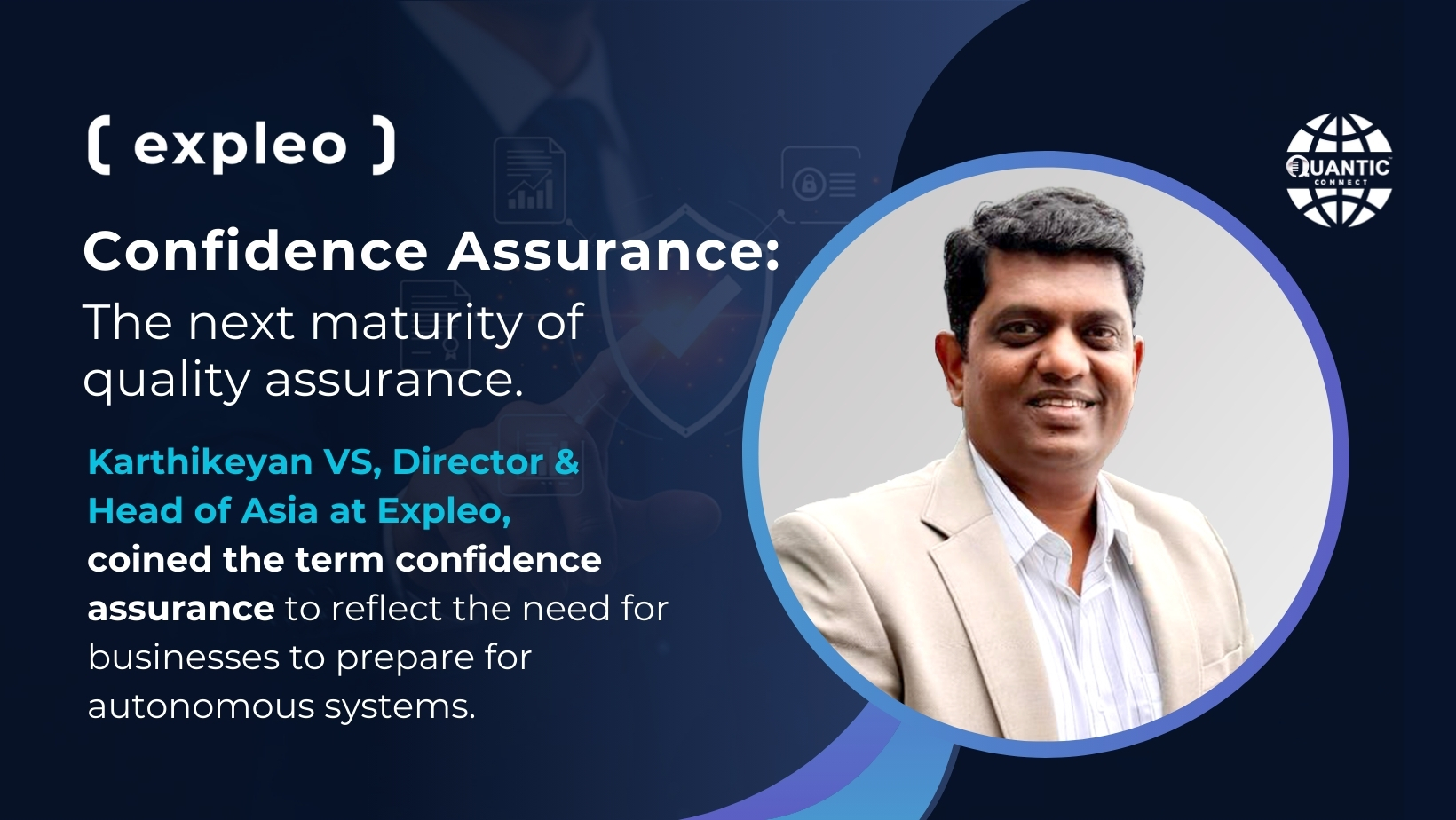
Bengaluru, 6th March, 2026: As digital systems increasingly operate with autonomy, making decisions, adapting in real time, and influencing outcomes, organisations must rethink what “assurance” truly means. Traditional Quality Assurance, focused on validating functionality and detecting defects, is no longer sufficient. What is required instead is Confidence Assurance: a discipline that ensures trust, reliability, accountability, and regulatory confidence across the entire digital ecosystem, says Karthikeyan VS, Director & Head of Asia at Expleo.
At the Digital QA & Software Testing Show 2026, Marquis Fernandes, Director – India Business at Quantic India, had a thought-provoking exchange with Karthikeyan VS, Director & Head of Asia at Expleo, discussing the evolving shift from Quality Assurance to Confidence Assurance and what it takes for organisations to build trust in autonomous digital ecosystems
1. Why organisations must evolve from validating quality to assuring end‑to‑end confidence
In an AI‑driven world, system correctness alone does not guarantee trust. Artificial intelligence is reimagining organisational operations, shifting work, decision-making and execution at scale. And as autonomous and agentic systems interact with data, users, and other systems in ways that are non‑deterministic and continuously evolving, the traditional approach of ensuring defect‑free software can still produce unintended, opaque, or risky outcomes.
Which is why confidence assurance shifts the assurance mandate of moving the needle:
- from a mere defect detection to a reliable outcome.
- from functional validation to decision accountability.
- from point‑in‑time testing to enabling continuous trust.
This evolution will ensure that organisations are no longer just shipping software; they are deploying decision‑making systems. Therefore, confidence, aka trust, must be assured across data, tools, systems, models, workflows, user impact, regulatory obligations and so on.
2. How does confidence assurance safeguard explainability, auditability, and risk control in autonomous systems?
As systems begin to operate with minimal or no human intervention, assurance cannot be episodic or reactive. Confidence Assurance introduces a fundamentally different operating model.
Confidence assurance goes beyond observing how systems behave after deployment. It actively influences decision-making by embedding controls, guardrails, and transparency mechanisms directly into the system design and execution.
Autonomous systems demand always‑on assurance:
- Continuous logging of decisions, data inputs, and system actions.
- Real‑time evidence generation instead of audit preparation after the fact.
- Replayability and traceability of decisions to support accountability.
This approach replaces traditional periodic inspections with continuous auditability methodologies, aligned with how autonomous systems actually operate.
What is non-negotiable is the importance of having strong data and AI governance as it forms the foundation, ensuring that explainability, auditability, and regulatory expectations are met, not merely to check the compliance checkboxes, but as built‑in system properties.
3. What capabilities must confidence assurance professionals develop to build sustained digital confidence?
The shift from an age-old traditional practice requires a significant transformation in talent. Future assurance professionals must evolve from software testers to trust builders.
The professionals must expand their vision, adopt systems thinking over test-case thinking and understand how decisions propagate across interconnected systems, data pipelines, AI models, and human touchpoints, moving beyond isolated test scenarios to enterprise and ecosystem‑level reasoning.
In other words, the role demands fluency in:
- How AI and autonomous systems learn and adapt.
- Where bias, drift, and unintended behaviour can emerge.
- When human intervention is necessary, and how it should be triggered.
- Assuming risk, regulation, and ethics as core skills.
Assurance professionals must internalise regulatory expectations, ethical considerations, and societal impact, making governance a core competency, rather than an external dependency.
While automation remains essential, confidence cannot be entirely automated, as human intelligence is essential for:
- Interpreting ambiguous outcomes.
- Balancing innovation with risk.
- Making context‑aware decisions under uncertainty.
- Precision communication across the ecosystem.
Ultimately, professionals must be able to translate technical signals into clear, evidence-based narratives, enabling stakeholders to act decisively as risk escalates exponentially and time is non-negotiable.
Closing perspective
Confidence Assurance illustrates the need for a maturation of Quality Assurance for organisations to function seamlessly in an autonomous, AI‑driven world, where assurance is no longer only about proving systems work, but also about ensuring they can be trusted.
Businesses that embrace Confidence Assurance will not only meet regulatory requirements and achieve operational excellence but also earn sustained digital confidence across their entire ecosystem.
