


Delhi, 4th September 2025: A rapidly evolving digital economy requires building resilient platforms, modernizing legacy systems, and embedding intelligence into workflows. They’re essential to staying relevant. Whether it’s accelerating financial services, ensuring regulatory-grade security, integrating AI into complex industries like healthcare, or balancing scalability with developer experience, leaders today must constantly navigate the fine line between innovation and reliability. Along these, lessons from past disruptions, a vision for future impact, and a people-first approach to teamwork shape not just technology outcomes, but also enduring leadership practices.
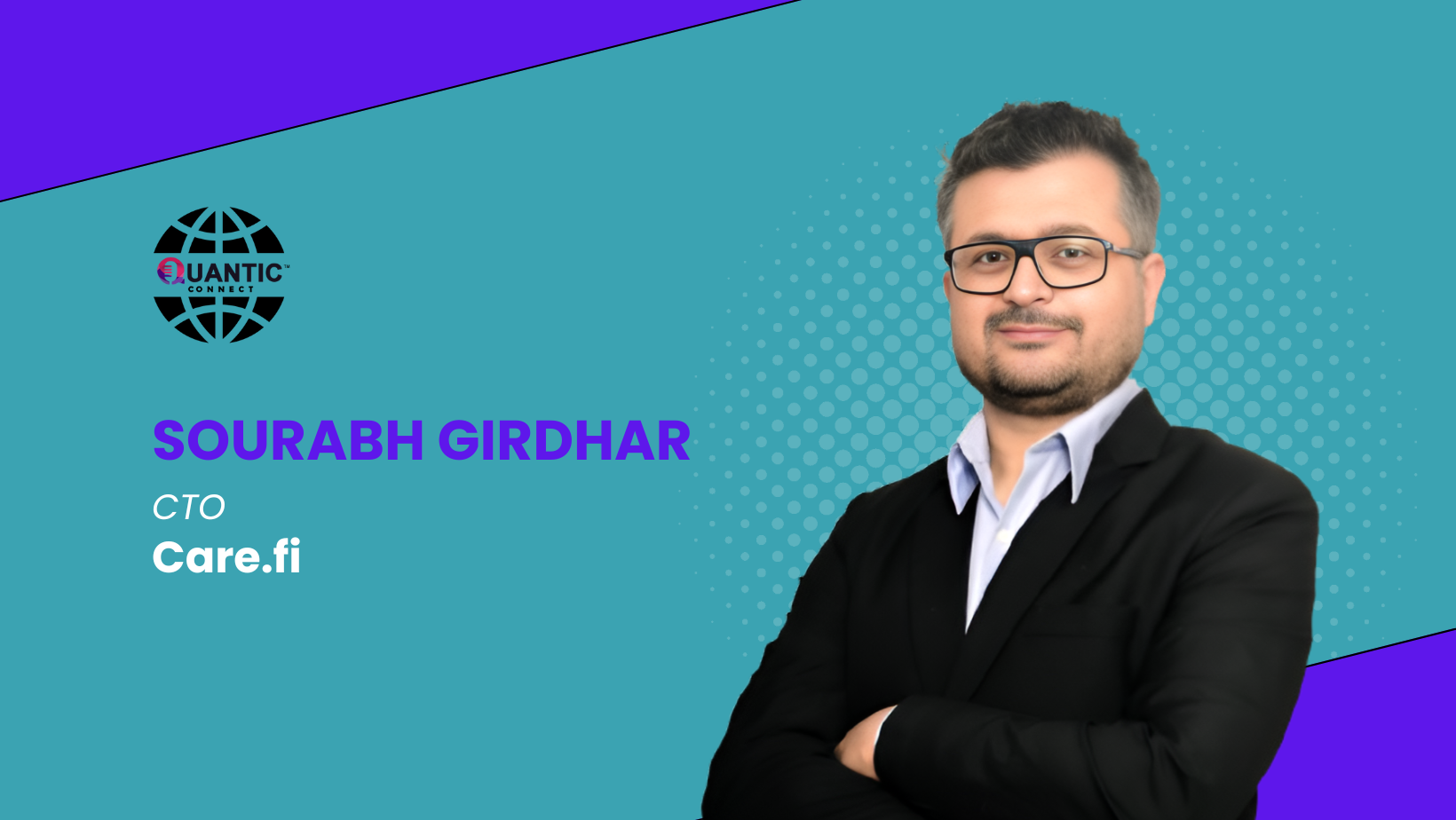
Join Mr. Marquis Fernandes (Director India Business – Quantic India), in a thought-provoking dialogue with Mr. Sourabh Girdhar who is the CTO at Care.fi. In this conversation, Mr. Sourabh shares his perspective on leading transformation at scale, spanning cloud modernization, building resilient data-driven ecosystems, and embedding intelligence across business workflows. He brings forward not just technical playbooks, but also the leadership mindset that enables fintechs, healthcare organizations, and enterprises to thrive amid disruption.
Q: How did you architect Care.fi’s digital lending platform to reduce approval times from days to minutes, what were the non-negotiable design principles that enabled both speed and regulatory-grade security?
To architect Care.fi’s digital lending platform and achieve the reduction of approval times from days to minutes, the foundational approach centered on automated decision-making, seamless integration of third-party data sources, and a robust compliance framework.
Key Architectural Elements:
- We implemented an end-to-end digital onboarding journey powered by advanced Know Your Customer (KYC) and credit scoring algorithms. These leveraged real-time data from verified sources such as government APIs, financial institutions, and credit bureaus, minimizing manual intervention and allowing instant data validation.
- The platform’s microservices-based architecture facilitated modular scalability, rapid deployment of new features, and parallel processing, critical to supporting high throughput and sub-minute response times.
- Models were embedded to continually refine credit risk assessment, further streamlining approval flows without sacrificing diligence.
Non-Negotiable Design Principles:
- Speed through Automation: Every process, from application to risk assessment, was designed to maximize automation, reducing dependency on manual review and preventing bottlenecks.
- Regulatory-Grade Security: Data encryption at rest and in transit, strict access controls, and continuous audit trails were instituted to meet and often exceed regulatory standards.
- Zero-Compromise Compliance: All integrations and core business logic strictly followed RBI and other regulatory policies, with built-in compliance checkpoints and automated reporting to ensure ongoing conformity.
- System Reliability and Integrity: The platform was engineered with high availability, redundancy, and disaster recovery, ensuring uninterrupted service and robust consumer trust.
By balancing these principles, Care.fi’s digital lending platform delivers rapid approvals while steadfastly upholding regulatory expectations and user data security, a standard that sets industry benchmarks for both innovation and integrity.
Q: Legacy-to-cloud transformations often fail due to hidden interdependencies. What technical playbook did you follow to achieve 99.99% uptime and 30% cost reduction while modernizing systems?
To achieve 99.99% uptime and a 30% cost reduction during the legacy-to-cloud modernization, we executed a meticulously structured technical playbook centered on transparency, resilience, and ongoing optimization.
Technical Playbook
- Thorough Assessment & Dependency Mapping: The transformation commenced with a comprehensive audit of legacy systems to reveal hidden interdependencies and performance bottlenecks. This enabled precise planning, risk mitigation, and prioritization, ensuring that critical dependencies were systematically addressed before migration.
- Cloud-Native Architecture for Resilience: Applications and workloads were redesigned for high availability with multi-region deployment and availability zone redundancy. Continuous data replication and automated failover mechanisms further reinforced the platform’s uptime.
- Observability & Automated Recovery: Advanced monitoring and observability platforms were integrated across migrated systems to provide real-time anomaly detection and automate remediation. This allowed for rapid incident response and seamless disaster recovery, ensuring near-zero interruptions and fulfilling stringent uptime guarantees.
- Cost Optimization & Financial Discipline: Post-migration, the team instituted robust cost governance using cloud management best practices such as auto-scaling, rightsizing, reserved capacity utilization, and automated decommissioning of obsolete resources. Continuous cost review cycles were enforced to ensure sustained savings, which directly contributed to a documented 30% reduction in operating expenditure.
- Security, Compliance, and Automation: Security protocols included end-to-end encryption, granular access controls, and continuous compliance monitoring. Automated CI/CD pipelines and API-based integrations drastically minimized manual intervention, driving operational consistency and reducing error rates.
Non-Negotiable Principles
- Operational Transparency: End-to-end monitoring enabled trackable uptime and proactive incident management.
- Cloud-Native First Approach: Wherever feasible, systems were re-factored or re-platformed to fully leverage cloud scalability and maintainability.
- Automated Governance: Routine audits and policy enforcement mechanisms maintained cost efficiency and high reliability
Q: RevNow integrates AI into the highly fragmented RCM workflow. What were the biggest technical and data engineering challenges in ensuring real-time decisioning and accuracy across the claims lifecycle?
Integrating AI into RevNow’s highly fragmented Revenue Cycle Management (RCM) workflow presented substantial technical and data engineering challenges, especially around ensuring real-time decisioning and uncompromised accuracy throughout the claims lifecycle.
Major Technical and Data Engineering Challenges
- Data Fragmentation and Normalization: The RCM ecosystem is characterized by disparate data sources, EHR systems, payers, billing platforms, with inconsistent formats and quality. Orchestrating seamless data ingestion, cleaning, and normalization was essential to forming a unified foundation for AI-driven insights.
- Latency and Real-Time Processing: Delivering decisions in real time meant architecting low-latency data pipelines. We leveraged event-driven microservices and in-memory processing frameworks to minimize delays, enabling near-instant adjudication and resolution of claims.
- Interoperability and Integration Complexity: Ensuring compatibility with dozens of legacy platforms and maintaining reliable bi-directional data flows demanded robust API strategies, dynamic mapping engines, and error-tolerant connectors.
- Accuracy amid Regulatory and Financial Complexity: Claims processing is governed by complex payer rules and compliance requirements. AI models needed to be trained on vast, high-quality datasets representing diverse scenarios, with continuous validation and retraining cycles to maintain regulatory-grade accuracy.
- Data Security and Compliance: Handling sensitive patient and financial data required rigorous implementations of encryption, access control, and audit logging across the data engineering stack, meeting the data privacy and relevant standards.
- Scalability and Fault Tolerance: The entire system was architected for elastic scalability, with distributed data storage and failover mechanisms ensuring uninterrupted service, even at peak loads or during subsystem failures.
Q: Scalability often clashes with maintainability in fintech stacks. How do you ensure your systems are both future-proof and developer-friendly, especially under high growth and tight release cycles?
Ensuring systems are both future-proof and developer-friendly, particularly in the dynamic realm of fintech, requires meticulously balancing scalability and maintainability through strategic architectural choices and process discipline.
Approach to Future-Proof, Developer-Friendly Systems
- Modular, Service-Oriented Architecture: I enforce a microservices-based or modular monolith approach, enabling independent scaling of components while keeping codebases manageable. This clarity both accelerates development during rapid growth and simplifies long-term maintenance.
- API-First Design & Reusable Interfaces: Strict adherence to well-documented, versioned APIs ensures seamless integrations and easy enhancement. Developers can work in parallel, reducing bottlenecks even under tight release deadlines.
- Automated Testing & CI/CD Pipelines: Comprehensive unit, integration, and security testing, embedded within automated CI/CD workflows, keep deployments reliable and regressions minimal. This enables frequent, predictable releases without sacrificing stability.
- Transparent Documentation & Developer Tooling: Robust documentation and intuitive onboarding materials allow new engineers to ramp up quickly, while standard coding conventions prevent fragmentation as teams scale.
- Performance and Resource Observability: Integrated monitoring and logging systems offer real-time visibility into application health, informing proactive optimizations and facilitating rapid root cause analysis when issues arise.
- Culture of Refactoring and Technical Debt Management: Regular technical debt assessments and scheduled refactoring sprints are prioritized alongside feature development. This makes the stack resilient to technological shifts and enables continuous innovation.
By operationalizing these principles, I create stacks that not only scale confidently with business growth but remain straightforward to extend, maintain, and refactor, empowering developers and future-proofing technology investments through every growth cycle.
Q: What’s a career-defining moment you laugh about now but taught you a key leadership lesson?
I used to work at Lehman Brothers in 2008 during the financial crisis. I vividly remember attending a party on Sunday night, September 14th, in Mumbai and returning home late. Early the next morning, around 6 AM, my roommate woke me up and told me that my company was gone. Getting into Lehman had been a significant achievement for me, as I had cleared seven to eight rounds of interviews. It was one of the best places to work, so I was shocked and devastated by the sudden collapse.
The days that followed were filled with overthinking and a flurry of interviews. Eventually, things settled down about 45 days after the bankruptcy. Now, when I look back, I think about the experiences I had, they sometimes make me laugh and remind me that some things are simply beyond our control. The key is to always give your best and stay consistent, no matter what the outcome might be.
Q: You’ve led digital innovation in fintech and healthcare, what’s that one domain you would like to disrupt next? And why?
I have recently begun working in the healthcare sector, and I believe we have only just begun to explore its vast potential. Healthcare is a large industry ripe for disruption. Despite the steady increase in healthcare needs and the daily opening of new hospitals, there remains a significant shortage of beds and resources. Numerous aspects within healthcare present opportunities for providers to enhance quality and concentrate on patient care by harnessing advanced technologies such as AI.
Another area to disrupt is education technology (EdTech). The reason is twofold. First, I strongly believe that equitable access to quality education is the foundation for solving many of society’s other challenges, including financial literacy and public health. Second, despite the recent progress in EdTech, there is significant opportunity to apply the same rigor and user-centric digital transformation that has revolutionized other sectors. Leveraging AI, adaptive learning, and data-driven personalization, I’d aim to close the achievement gap and empower learners of all backgrounds to realize their full potential. The impact of innovation in education can ripple through generations, making it truly transformative.
Q: What does a healthy team practice look like under your leadership?
These are my hallmarks for creating a healthy Team
- Clear Objectives and Shared Purpose: Every team member understands not just their role but the collective mission, ensuring alignment and mutual accountability.
- Open Communication and Psychological Safety: I foster platforms where diverse perspectives are welcomed and constructive feedback flows freely. Mistakes are treated as learning opportunities, cultivating an atmosphere where individuals feel safe to challenge, innovate, and contribute.
- Skill Development and Growth: Regular mentorship, stretch assignments, and access to learning resources empower team members to continually advance their expertise and career goals.
- Recognition and Wellbeing: Achievements are consistently celebrated, while attention is paid to work-life balance, mental health, and holistic well-being, leading to sustained enthusiasm and productivity.
- Inclusive Decision Making: Team input is actively sought and valued in strategic choices, ensuring that decisions are well-informed and broadly supported.
As industries continue to evolve, the true differentiator will not just be technology itself, but the mindset and discipline with which it is applied. From embracing automation and cloud-native architectures to reimagining healthcare and education through AI, the opportunity lies in blending speed with security, scale with simplicity, and vision with execution. Above all, success depends on building resilient teams that innovate with confidence, adapt with agility, and never lose sight of the human impact behind every digital transformation.
