



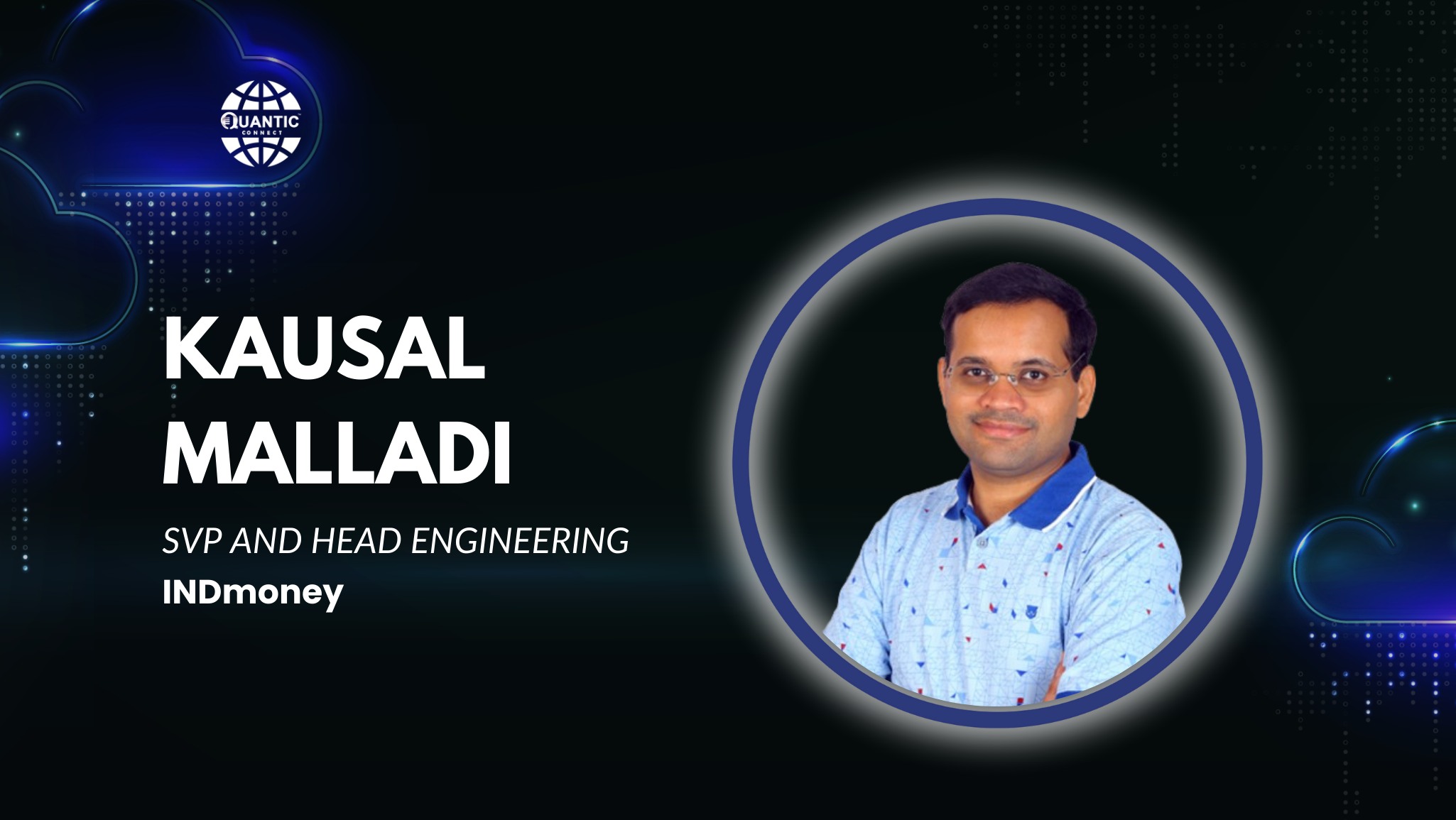
Bengaluru, 11th September 2025: In today’s technology landscape, engineering leadership is as much about mindset as it is about technical mastery. With over 14 years of experience building, scaling, and mentoring high-performing teams, our guest has navigated paradigm shifts from microservices to AI while balancing speed, resilience, and trust in some of the most demanding domains like BFSI. His journey reflects not just a commitment to robust architecture and metrics-driven culture, but also a deep belief in ownership, continuous learning, and human support systems.
Join Mr. Kausal Malladi, SVP & Head Engineering at INDmoney in an engaging conversation with Mr. Marquis Fernandes who spearheads the India Business for Quantic India. In this conversation, Kausal shares candid insights on balancing agility with resilience, instilling habits that define engineering excellence, designing trustworthy AI systems, and the personal lessons that shape him as both a leader and an individual.
- Many engineering leaders emphasize speed of delivery versus system resilience. When you’re architecting for scale, how do you personally strike that balance without compromising either?
Balancing speed of delivery with system resilience is critical for building scalable software. My approach centers on iterative development paired with robust architectural foundations. For instance, in a four-week project, I break the problem into smaller, deliverable units, enabling weekly releases to validate both product impact and technical performance. By monitoring key metrics like latency and resource usage early on, we can iterate and refine designs as needed. However, this agility is underpinned by meticulous planning before execution begins. By prioritizing a strong architectural blueprint, focusing on modularity, scalability, and fault tolerance, we ensure that speed doesn’t come at the expense of reliability, delivering value quickly while maintaining long-term stability.
- You’ve mentored teams from the ground up, what’s the one “early cultural habit” you always instill in new teams to set the foundation for long-term success?
I instill a metrics-driven mindset as the cornerstone of engineering excellence. Every line of code, every byte transferred over wire, and every network interaction, affects scalability and performance. Without visibility into these metrics, optimization is guesswork. From day one, I guide teams to instrument their code comprehensively, tracking latencies, infrastructure metrics, and system behavior. This habit transforms how engineers approach problem-solving, fostering a culture of continuous improvement. Just as product managers obsess over funnel conversions, engineers should relentlessly pursue technical metrics, always wearing an “optimization hat” to drive software excellence.
- In BFSI and other sensitive domains, AI integration often collides with regulation and trust. How do you design systems that are not just technically sound but also inspire stakeholder confidence?
In sensitive domains like BFSI, trust and compliance are as critical as technical excellence. My approach integrates security and regulatory requirements into every layer of the system design. From the outset, we align our architectures with industry standards, embedding security controls and compliance checks into the development process. By proactively addressing potential vulnerabilities and ensuring transparency in how data is handled, we build systems that not only perform reliably but also earn stakeholder trust. Regular audits, clear documentation, and collaboration with compliance teams further reinforce confidence, ensuring our solutions meet both technical and regulatory expectations.
- With 14+ years of engineering leadership, you’ve witnessed multiple paradigm shifts in software development. Which shift micro-services, containerization, or AI, do you think will have the longest-lasting impact, and why?
Microservices architecture stands out for its enduring impact. Its core principles, decoupling components, maintaining separation of concerns, and enabling independent scaling, are foundational to modern software design, regardless of the technological paradigm. Whether integrating AI or leveraging containerization, microservices provide the flexibility and resilience needed to adapt to evolving demands. I’ve seen poorly designed systems become unmanageable without these principles, while well-executed microservices architectures remain robust and scalable over time. Their domain-agnostic nature makes them a bedrock for innovation, ensuring long-term relevance.
- Can you share a project (professional or personal) that taught you more through its failures than its successes?
While building INDstocks at INDmoney, our pursuit of the fastest trading experience in India revealed critical lessons through its challenges. The ambition to minimize latency exposed systemic issues, integration bottlenecks, flawed assumptions, and infrastructure limitations. Each issue we uncovered became an opportunity to refine our approach, from optimizing integrations to rethinking assumptions. These also deepened our domain knowledge and technical expertise, ultimately enabling us to deliver India’s fastest trading platform. The process of diagnosing and resolving these challenges was a masterclass in resilience and problem-solving with ultimate fault-tolerance.
- What’s the one “non-obvious” skill outside pure technology that you think every aspiring engineering leader should cultivate?
Ownership is the non-obvious skill that defines great engineering leaders. It transcends technical expertise, applying to every facet of life, work, home, or volunteering. At work, ownership means taking full responsibility for a project’s lifecycle, from coding to deployment, monitoring, and maintenance. This mindset ensures accountability and drives excellence, as leaders who own their work inspire their teams to do the same. Cultivating ownership transforms challenges into opportunities and fosters a culture of commitment and success.
- How do you balance family life with your demanding professional role?
Balancing a demanding career in a startup with family life requires a strong support system. Over the years, I have been fortunate to have an incredible support system – my parents, wife, children, sister, and extended families, who stood by me to enable me to give my all at work. Their sacrifices allow me to operate with the intensity startups demand, where ownership feels like co-owning the company. By leaning on this support and maintaining open communication, I ensure that both my professional and personal lives thrive, even under pressure.
- What is the one piece of financial advice you would like to give to your younger self?
Diversify your investments, don’t put all your eggs in one basket. Spreading risk across multiple avenues ensures greater financial resilience and opportunity for growth.
As this conversation highlights, true engineering leadership lies at the intersection of technical mastery, cultural stewardship, and personal resilience. Whether it’s balancing speed with scalability, embedding trust into regulated systems, or cultivating ownership beyond technology, the lessons shared here reflect a mindset that goes deeper than code, it’s about building teams, products, and systems that endure. By embracing metrics-driven rigor, learning from failures, and leaning on both professional discipline and personal support, our guest reminds us that sustainable success in technology is not just about what we build, but how and why we build it.
