



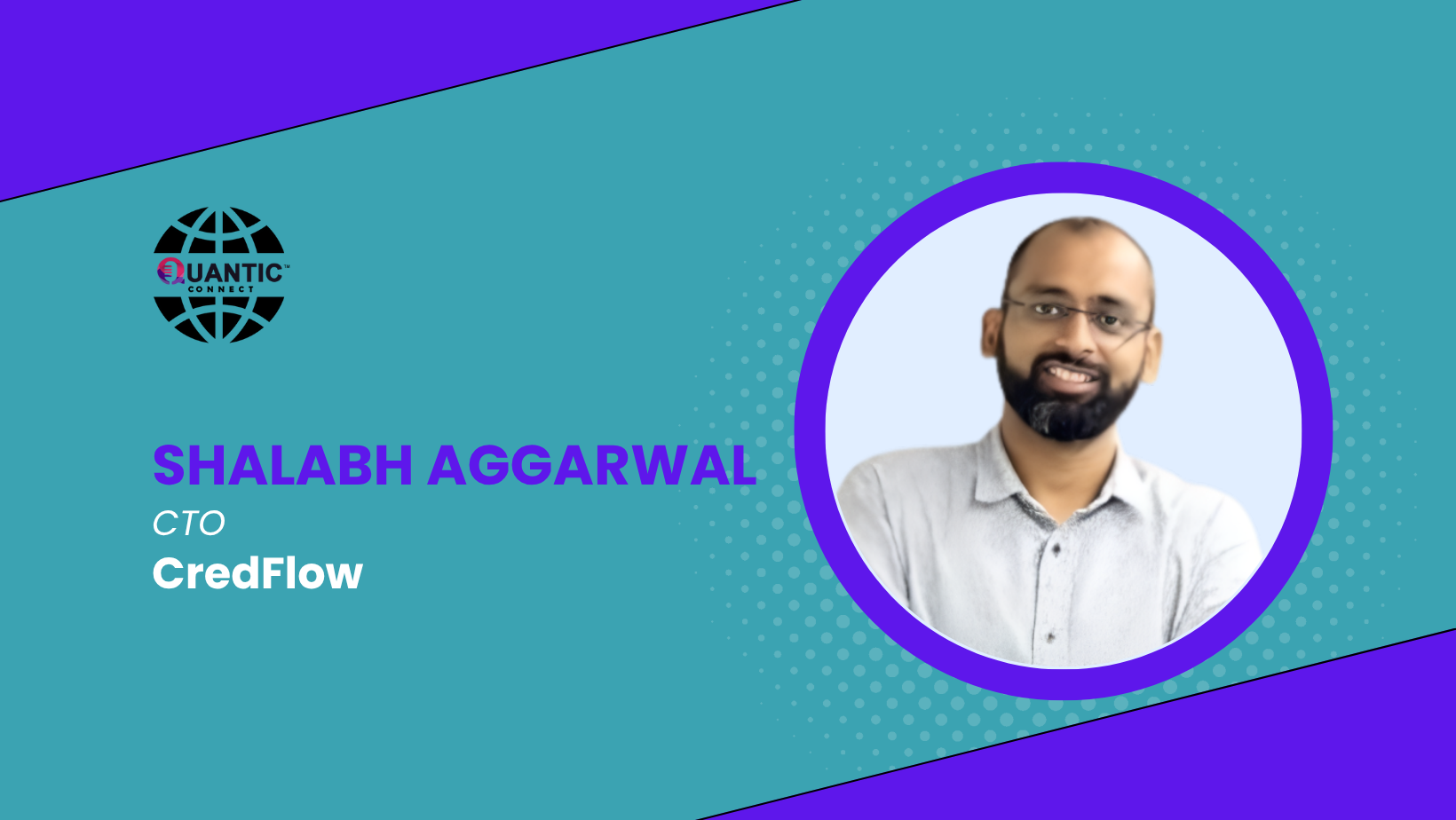
Delhi, 10th October 2025: In today’s rapidly shifting tech landscape, leadership is no longer defined solely by code or systems, but by the ability to build empowered, outcome driven teams that can adapt across geographies and industries. From authoring the Flask Framework Cookbook to leading high growth engineering teams at BharatPe, Savii, and CredFlow, Mr. Shalabh has consistently bridged deep technical expertise with strategic business impact.
Join Mr. Shalabh Aggarwal, CTO at CredFlow in an engaging conversation with Mr. Marquis Fernandes who spearheads the India Business at Quantic India, as he shares lessons from building scalable architectures, driving AI, powered innovation in FinTech, and leading global teams with empathy, offering candid insights for the next generation of CTOs.
You’ve operated across India, the US, and Southeast Asia, what core tech leadership principle remains universal, and what were the major differences you spotted?
One principle I’ve found to be universal, whether in India, the US, or Southeast Asia, is that technology leadership is really about people, not systems. No matter where you operate, the ability to build self organizing, outcome driven teams that take ownership is what differentiates good engineering from great engineering. Code, architecture, or tools may vary, but empowered teams who understand business goals and feel trusted to deliver will always outperform.
That said, the context changes. In India, you often find incredible raw talent hungry to learn, but it needs structure and mentorship to scale. In Southeast Asia, particularly in markets like the Philippines or Indonesia, adoption cycles for new products are different, you need to build with a sharper focus on user trust, compliance, and education. In the US, the maturity of engineering culture is higher; teams are more accustomed to autonomy, but with that comes the expectation of transparency and strong communication.
So while the core principle of cultivating ownership and clarity remains constant, the way you apply it, whether through process discipline, cultural alignment, or communication, needs to adapt to the local ecosystem. The best leaders don’t impose one model everywhere; they translate their principles into the language of the teams and markets they operate in.
As an author of the Flask Framework Cookbook and an early open source contributor, how do you view the evolving role of backend frameworks in enabling rapid innovation in AI and FinTech today?
When I wrote the Flask Framework Cookbook years ago, the focus was on giving developers a lightweight, modular way to build quickly without being boxed in by heavy frameworks. That philosophy, speed, simplicity, and extensibility, has become even more relevant today, especially in AI and FinTech.
In modern FinTech, backend frameworks aren’t just about handling requests; they are the foundation for experimentation and rapid iteration. Whether you’re plugging into NBFCs, embedding KYC workflows, or integrating LLM, powered AI agents, you need a backend that is secure, modular and adaptable. Frameworks like Flask, Django or FastAPI enable that agility, they let teams go from prototype to production in weeks, sometimes days, without compromising on compliance or scale.
In AI, the shift is even more interesting. Backend frameworks are now the glue between AI models and real world business workflows. At CredFlow, for instance, we’ve built agentic AI systems that automate lending back office processes. The backend doesn’t just serve APIs; it orchestrates NLP, OCR, LangChain and underwriting logic seamlessly. Without flexible frameworks, that integration would take months instead of weeks.
So, to me, the evolving role of backend frameworks is this: they are no longer just scaffolding for apps, they are innovation accelerators. They allow companies to marry the cutting edge (AI/ML) with the mission critical (FinTech reliability and compliance), which is exactly what the next decade of financial technology will demand.
If you had to mentor a first time CTO building a B2B SaaS product in 2025, what one technical decision would you insist they get right early, and why?
If I had to give just one piece of advice to a first, time CTO building a B2B SaaS product in 2025, it would be this: get your architecture for scale and modularity right from day zero.
Most early stage teams rush features to market, which is natural, but they often hardwire complexity into their systems. Six months later, they’re buried under tech debt, firefighting outages, and struggling to onboard new engineers. In B2B SaaS, where your product is mission critical for clients, reliability and extensibility matter as much as speed.
I would insist they design their system as modular, API first and cloud native, even if it feels like overkill in the early days. That doesn’t mean building a perfect microservices setup on day one, it means making choices that allow you to pivot, plug in AI, add geographies, or serve larger enterprise clients without rewriting the whole stack.
At CredFlow, this thinking allowed us to embed AI, driven underwriting workflows and on board NBFC integrations in weeks, not months. The same principle applied at BharatPe, where a clean services, based architecture let us scale lending volumes 15x in six months.
In short: product features will always evolve, but if you’re foundational architecture is clean, simple and adaptable, you’ve given yourself the freedom to innovate without breaking. That’s the single most valuable decision a new CTO can make.
You’ve worked with teams globally. What’s the funniest or most unexpected moment you’ve had while working remotely across time zones?
Working across time zones always throws up surprises, but one that still makes me smile happened during a late night call with a Southeast Asia team. We were deep into discussing lending workflows and suddenly one of our senior engineers’ kids walked into the frame dressed as Spider Man, announcing loudly that he was here to “save the release!” The entire Zoom room burst into laughter and what could have been a tense architecture review instantly became one of our most memorable calls.
Another unexpected moment has been how differently teams approach deadlines across geographies. In India, there’s an incredible sense of “jugaad”, people will stretch, improvise and somehow deliver by midnight. In Southeast Asia, I noticed teams prefer a steadier rhythm and won’t compromise on process just to push something out. Both approaches have merit, but it taught me that as a leader, you can’t enforce one cultural rhythm globally, you have to blend urgency with discipline depending on the team’s context.
For me, these moments, whether it’s a superhero cameo in a Zoom meeting or learning how cultures approach work, are great reminders that technology leadership isn’t just about code and systems. It’s about embracing the human side of teams, no matter where they’re located.
You’ve led high, growth teams, written books, and contributed to open source. When was the last time you felt completely out of your comfort zone, and what did you learn from it?
The last time I truly felt out of my comfort zone was when I transitioned from being a pure technologist to taking on broader business responsibilities, particularly during my shift into fintech leadership roles where technology decisions directly impacted revenue, compliance, and customer trust. Suddenly, it wasn’t just about clean architecture or efficient code; it was about balancing engineering tradeoffs with financial risk, regulatory expectations and market speed.
At first, I found myself over-optimizing the tech stack while underestimating how quickly business priorities could shift. It was uncomfortable because it forced me to let go of being “the smartest engineer in the room” and instead learn to be a translator between business and engineering.
What I learned is that real leadership begins where your expertise ends. When you’re slightly uncomfortable, you’re in the zone where growth happens. Today, I actively seek out those situations, whether it’s embedding AI into underwriting at CredFlow or negotiating with NBFC partners because they stretch me beyond technology and into the realm of strategy, influence and impact.
In hindsight, that discomfort was a gift. It taught me that the role of a modern CTO isn’t just to build systems, it’s to bridge ambition with execution, even when the path forward isn’t fully clear.
If you could write a non-tech book tomorrow, what would its title be and what would it explore?
If I were to write a non-tech book tomorrow, the title would be: “The Self Organizing Team: How to Build High Performance without Micromanagement.”
The book would explore my core belief that great teams don’t need to be managed, they need to be enabled. Over the years, whether at 3Pillar, BharatPe, Savii, or CredFlow, I’ve seen that when you strip away unnecessary complexity, give people clarity of purpose and create room for ownership, teams begin to organize themselves. That’s when real speed and innovation happen.
It would go beyond processes or frameworks and dive into the mindset shifts leaders need to make: trusting outcomes over oversight, prioritizing simplicity and creating an environment where leaders naturally emerge from within the team. To me, that’s the secret of high performance cultures, it’s not about adding more control, but about removing friction so people can excel.
In a sense, it would be a playbook for leaders who want to build companies that scale not by adding layers of management, but by unleashing the full potential of their teams.
As this conversation with Mr. Shalabh Aggarwal reveals, true technology leadership lies in balancing clarity of vision with adaptability and technical depth with human empathy. From championing modular architectures to enabling AI-driven financial innovation, his journey underscores that great leaders don’t just build systems, they build cultures of trust, ownership, and resilience. For aspiring CTOs and business leaders alike, his insights serve as both a guide and a reminder: innovation thrives not in control, but in empowering teams to think, act and grow beyond boundaries.
